Elizabeth Regis

The Peace Dividend Is Over: Rethinking Defense in Portfolios 

The peace dividend many of us were born into has expired.

We’re entering a new geopolitical reality—one where defense investment can no longer be ignored, even in the most ethically constrained portfolios. Whether you’re in a public pension, a family office, or a university endowment, the relevance of defense—both from a return and a risk management perspective—is rising fast. The question is no longer if you should think about defense exposure, but how you approach it.

Context: A New Strategic Normal

In my early days working at a pension fund, defense exposure was marginal—both in scale and scrutiny. But at Axxets today, that conversation is shifting.

The war in Ukraine, tensions in the South China Sea, and increasing cyber threats have created a multipolar environment with fragmented alliances and local conflicts. These aren’t isolated skirmishes—they represent a structural shift. Defense spending is no longer cyclical; it’s foundational.

This shift is being echoed across markets:

  • Anduril in the U.S. is pushing forward dual-use defense tech that sits at the edge of AI and autonomy.
  • Rheinmetall is playing a growing role as Europe seeks defense sovereignty.
  • Turkey’s defense industry has become a powerhouse in drone and missile development.
  • Even Nigeria is stepping up as ECOWAS’s security guarantor—something unthinkable a decade ago.

This isn’t just about legacy players like Lockheed or Raytheon anymore. The industry is evolving—and fast.

Insight #1: Defense as Strategic Infrastructure

One lesson we’ve learned is that defense is increasingly analogous to energy or cybersecurity—a non-optional sector underpinning state functionality. For many regions, it’s also an employment engine and a source of technology spillovers.

While traditional defense primes are still important, we’re seeing compelling innovation at the intersection of software, AI, and autonomy. These startups—and the venture capital flowing into them—are modernizing the defense sector with scalable, modular solutions that can support both military and civilian uses.

For allocators, this means the entry points are no longer limited to defense ETFs or legacy primes. Private capital is playing an increasingly important role in shaping the industry’s next chapter.

Insight #2: Valuations and Volatility Are Real

The reality is more nuanced than “defense is back.” High valuations—often pushing P/E ratios near 40x—aren’t uncommon. Much like in AI, investors must be selective and realistic about what’s already priced in.

Add to that policy risk and export restrictions, and you’ve got a highly reactive asset class. For example, a shift in U.S. foreign policy can cancel contracts overnight.

In practice, this means we focus on:

  • Dual-use technologies with civilian applications.
  • Localized players with government backing and cost advantages.
  • Suppliers in NATO-adjacent markets adapting to new procurement frameworks.

Being thoughtful here isn’t just ethical—it’s also practical portfolio construction.

Insight #3: Ethics, Exposure, and the Investment Dilemma

At Axxets, we’ve had internal debates on how to incorporate defense. It’s a conversation that balances fiduciary responsibility with family values.

Defense investing isn’t binary.

It can include supply chain tech, cybersecurity, drone navigation, AI systems, and encrypted communication platforms—each sitting on a spectrum from commercial to military use.

That said, not investing in the sector is also a choice—with its own trade-offs. Ignoring the conversation entirely risks missing exposure to a sector reshaping global power dynamics and, by extension, markets.

Final Thought: Don’t Skip the Conversation

Defense is no longer a niche or optional allocation. Whether your conclusion is to invest or to consciously exclude it on ethical grounds, the conversation must be had.

Because in a world where geopolitics directly shapes returns, sitting on the sidelines is itself a decision—one that should be made thoughtfully, not passively.

What role does defense play in your portfolio today? Is it time to revisit that assumption?

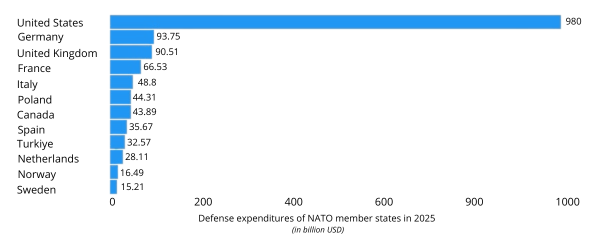
Source: STATISTA
Mixed outlook between inflation and growth 

Key data on inflation, consumption, and growth shape the start of 2026 

This week, markets reacted to mixed signals: stable U.S. inflation, positive surprises in retail sales, and uneven growth across Europe. Meanwhile, China strengthened its global trade presence, and Argentina closed the year with its lowest inflation in eight years. 

United States 

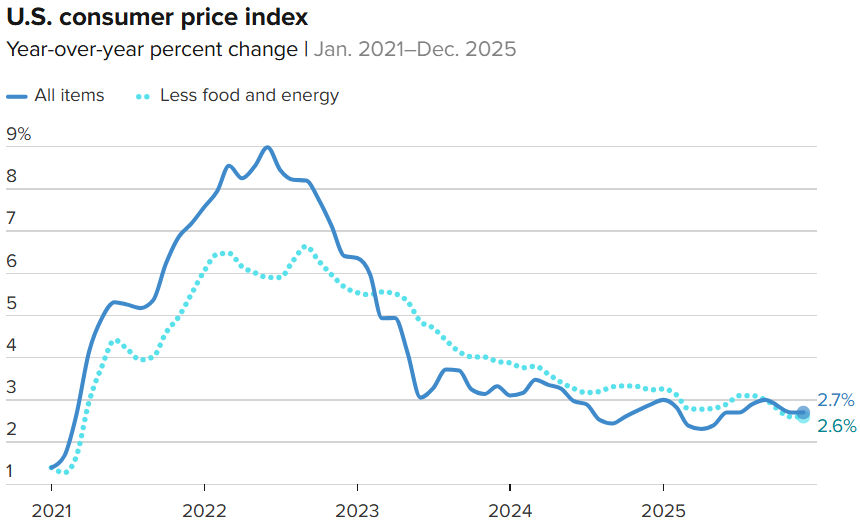
Headline inflation held at 2.7% and core inflation at 2.6%. PPI rebounded to 3% due to energy. Retail sales rose 0.6%, pointing to a segmented consumption pattern. Projected GDP was revised to 5.1%. The earnings season begins with positive results from banks.

Europe 

Germany exits recession with 0.2% annual growth, though industrial activity remains weak. The United Kingdom surprised with 1.4% annual growth. Trade association BGA expects a modest recovery in Germany’s wholesale sector in 2026. 

Japan 

The prime minister will dissolve Parliament and call early elections. The Producer Price Index fell to 2.4% year over year in December, the lowest level since May, in line with expectations. 

China 

Posted a record trade surplus of $1.19 trillion in 2025. The decline in exports to the U.S. was offset by strong growth in shipments to Africa and Asia. 

Argentina 

Inflation closed the year at 31.5%, its lowest level since 2017. In December, prices rose 2.8%, driven by transportation, housing, and food. 

Brazil 

Retail sales increased 1.3% year over year in November. While positive, they remain below the historical average. 

Mexico 

The World Bank lowered its 2026 growth forecast to 1.3%. Fixed investment fell 5.5% year over year in October, although residential construction grew 13.5%. 

Key upcoming events 

  • United States: markets will be closed for the Martin Luther King Jr. Holiday 01/19 
  • United States: the final reading of Q3 GDP growth will be released on 01/22 

“The stock market is a device for transferring money from the impatient to the patient.” – Warren Buffett

Monitor

U.S. core inflation cools further 

U.S. core inflation came in softer than expected in December, reinforcing the view that underlying price pressures are gradually easing. Core CPI rose just 0.2% month over month and 2.6% year over year, both below consensus, pointing to a continued normalization of inflation dynamics. Still, headline inflation remains at 2.7%, meaning price stability has not yet been fully restored.

What’s holding the Fed back is the composition of inflation. Housing costs, more than a third of CPI, continue to rise at an elevated pace, while services, recreation, and airfares remain sticky. Even as some goods show deflation, the Fed is still waiting for economic data and assessing the effects of previous cuts, limiting the case for near-term rate cuts. Markets now expect the Fed to remain on hold at least through the first half of the year.

Market Implications

  • It reinforces the scenario of inflation slowing down, but too slowly to justify immediate interest rate cuts.
  • Risks in the housing and services sectors reduce the likelihood of an accelerated monetary stimulus cycle.
  • Makes upcoming inflation and labor data critical for market direction.

Source: CNBC with information from U.S. Bureau of Labor Statistics

U.S. Intervention in Venezuela: Market Implications 

U.S. forces captured Nicolás Maduro and his wife, Cilia Flores, in Caracas through an operation that included air strikes on military targets. President Trump stated that his administration will temporarily assume control of Venezuela’s governance. Venezuela’s Supreme Court subsequently appointed Delcy Rodríguez as interim president, leaving open the possibility that she could remain in power for an extended period.

Market Reaction: Limited Impact, Targeted Opportunities

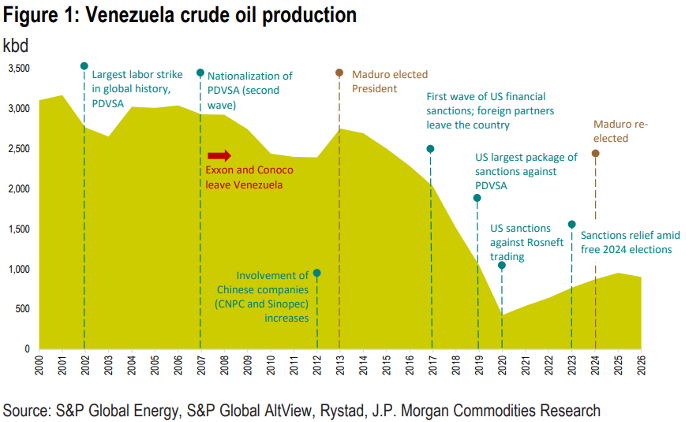
Initial market reactions were concentrated in commodities. Gold prices rose amid heightened geopolitical uncertainty, while oil prices edged modestly lower. Despite holding the world’s largest proven oil reserves, Venezuela’s oil production remains depressed at approximately 900–950 thousand barrels per day. With political stability and renewed licensing, production could increase by roughly 250 thousand barrels per day in the near term, reaching 1.3–1.4 million barrels per day within two years. A more substantial recovery, however, would require investments exceeding USD 200 billion, according to JP Morgan estimates.

From the perspective of traditional financial markets, Venezuela has marginal relevance. Its sovereign debt has been in default since 2017, with total external liabilities estimated at USD 150–170 billion. Nominal GDP, estimated by the IMF at USD 82 billion for 2025, is likely closer to USD 60 billion at current exchange rates—less than half of its pre-crisis size.

Pragmatism Over Idealism: Understanding the Potential Transition Phases

What is unfolding is not a conventional democratic transition, but rather a geopolitical operation consistent with historical precedents. We view the transition as potentially unfolding across three phases:

Phase 1: Containment and Control (Current)

The immediate priority is to prevent institutional collapse and widespread violence. This explains Delcy Rodríguez’s role in ongoing negotiations: she represents administrative continuity across ministries, PDVSA, and the banking system; maintains channels with the armed forces and intelligence services; and retains the ability to execute orders on the ground. In acute crises, operational control often outweighs electoral legitimacy.

Why is María Corina Machado not at the table? She does not control weapons, territory, or logistical infrastructure. For the core Chavista power structure, she represents an existential threat. President Trump was explicit: “I think it would be very difficult for her to be the leader. She does not have internal support or respect within the country.” Secretary Rubio added that “the vast majority of the opposition is no longer present in Venezuela,” further limiting the scope for immediate elections.

Phase 2: Power Rebalancing

Once security stabilizes, civilians, technocrats, and new political figures are expected to enter the process. This phase would involve institutional rebuilding, restoration of basic services, and international normalization.

Phase 3: Democratic Legitimation (Uncertain Timeline)

With functional institutions and contained violence, free elections and broader economic normalization become feasible. This sequencing is consistent with successful transitions observed in the Southern Cone and Eastern Europe.

Path to Reconstruction: Oil and Normalization

Secretary Rubio stated that the oil “quarantine” remains in place, affecting approximately 400 thousand barrels per day of exports, based on public data. Logical next steps would include formal diplomatic recognition and an expansion of licenses, eventually paving the way for debt restructuring.

A fast-tracked bilateral agreement anchored in oil—potentially outside the IMF framework—could lead to a less orthodox restructuring than under the G20 Common Framework. Under our estimates, Republic and PDVSA bonds would likely be treated similarly, potentially incorporating a value recovery instrument (VRI) linked to oil production or prices.

Opportunities for Sophisticated Investors

Venezuelan bonds approximately doubled in price during 2025, and we are currently observing an additional 8–10 point rally this week. In an environment where single-B emerging market sovereigns are trading at five-year low yields (7.6%) and 18-year tight spreads (343 basis points), Venezuela offers a combination of relative value and a compelling normalization narrative.

Given the scale of Venezuela’s oil resources and the U.S. administration’s determination to extract economic returns from its intervention, market participants are likely to remain constructive. Technical analysis suggests value in bonds without collective action clauses and in instruments where accrued interest is less fully reflected in market prices. That said, it is important to emphasize that visibility on a comprehensive debt restructuring remains limited, and there is statute-of-limitations risk for bonds purchased after the publication of the Tolling Agreement in August 2023, which extended the prescription period for defaulted bonds from 2023 to 2028.

For investors with higher risk tolerance, we see emerging opportunities that we are actively evaluating:

Sovereign debt restructuring: Bonds with still-valid maturities and more recent issuance dates could see higher recovery values, particularly as a way to minimize exposure to unpaid accrued interest, which could face significant haircuts in a restructuring scenario.

*Bond secured by 50.1% of CITGO Holdings shares

Traditional Financial Markets

While a potential lifting of U.S. sanctions and renewed investment could support higher oil production, the process would be complex and span multiple years, given decades of underinvestment and infrastructure deterioration. Venezuela currently represents roughly 1% of global oil supply, amid persistent political, legal, and security risks, as well as the structural disadvantage of producing extra-heavy crude, which is less valuable than light crude and reduces its attractiveness to international investors. As a result, we do not currently view this exposure as particularly compelling.

Direct exposure to publicly listed companies outside the energy sector is generally limited relative to oil, given the historical dominance of the state across large parts of the economy (including telecommunications and banking), as well as sanctions and capital controls. In this context, any potential upside for non-energy companies would depend primarily on policy reforms, sanctions relief, and improved legal and financial certainty, rather than near-term operational improvements.

For further discussion or to receive our detailed analysis, please contact your investment advisor at Activest.

Source: Internal analysis Activest

Global Economic Outlook: Mixed Signals 

In a relatively calm week, employment and consumption indicators provided key signals across major economies. Central bank decisions continue to reflect a cautious, data – dependent approach, while global economies show divergences between production and consumption that reinforce the need for selective analysis heading into 2025.

United States 

  • Nonfarm payrolls exceeded expectations, adding 64,000 jobs in November. 
  • The unemployment rate rose to 4.6%. 
  • Headline inflation eased to 2.7% and core inflation to 2.6%. 

Europe 

  • The ECB held rates at 2.15% and revised its growth outlook. 
  • Eurozone inflation stood at 2.1%. 
  • Germany and Spain recorded 2.6% and 3.2%, respectively. 
  • The United Kingdom cut its policy rate to 3.75%. 

China 

  • Industrial production grew 4.8% year over year in November. 
  • Retail sales rose just 1.3%, the weakest increase since December 2022. 
  • Sharp declines in automobiles, household appliances, and construction materials. 

Argentina 

  • GDP expanded 3.3% year over year in 3Q, below expectations. 
  • Manufacturing output declined 2.4%. 
  • The unemployment rate fell to 6.6%, approaching historical lows. 

Brazil 

  • Economic activity declined 0.2% month over month. 
  • Agriculture helped prevent a deeper contraction. 
  • The central bank revised its GDP growth forecast upward and maintained a restrictive stance to contain inflation. 

Mexico 

  • Banxico cut its policy rate to 7%. 
  • Retail sales increased 3.4% year over year, driven by strong online sales. 
  • Employment in the sector rose 1%, while wages increased 3.3%. 

“The first rule of compounding: Never interrupt it unnecessarily.” — Charlie Munger 

Key Upcoming Events 

  • United States: Quarterly GDP growth release — December 23 
  • United States: Labor market data release — December 24 

Monitor 

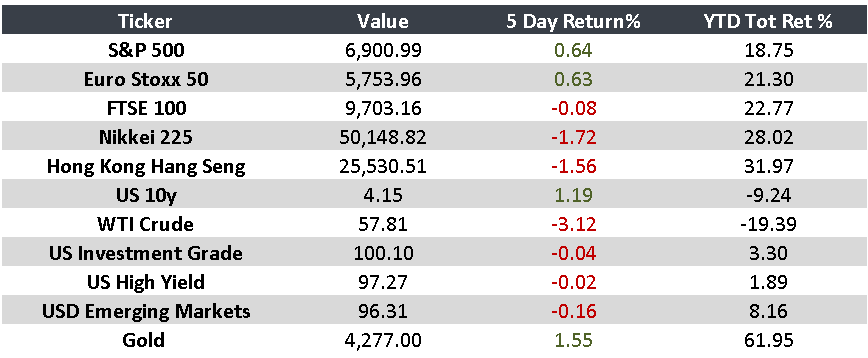
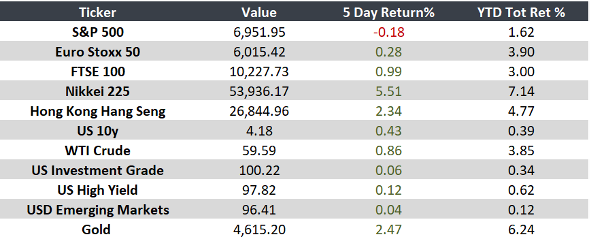
Returns as of 10 AM EST 

Private debt under pressure in a more challenging environment 

Private debt, though a core component of institutional portfolios for several years, is currently experiencing strong growth. However, a challenging macroeconomic backdrop and multiple structural forces are reshaping the dynamics of private financing.

Aging populations and declining birth rates are reducing demographic growth, further increasing the cost of capital. At the same time, the energy transition, national defense, digital infrastructure, and other strategic priorities require trillions of dollars in annual investment, creating fierce competition for scarce capital.

Additionally, regulatory pressure, deglobalization, and macroeconomic volatility are increasing liquidity risk across certain segments of private debt. While the asset class remains attractive due to its ability to generate above-market returns, a more rigorous assessment of credit risk has become essential.

Key Data: 

  • Aging populations increase the cost of capital 
  • Energy transition and infrastructure demand trillions annually 
  • Regulatory pressure and deglobalization heighten liquidity risk 
  • The era of cheap capital is over 

Conditions have changed. Selectivity and credit quality are now more important than ever. Although private debt offers attractive returns, the current environment demands more rigorous analysis. A disciplined approach to credit quality and liquidity risk assessment enables capturing opportunities without compromising portfolio soundness.

Source: Activest/Axxets Internal Analysis 

Fed splits opinions and key data ahead 

Markets reacted to the Federal Reserve’s latest rate cut amid a set of mixed signals on inflation, production, and employment across major economies. The week was shaped by U.S. labor data, an industrial rebound in Europe, and contrasting dynamics in Asia and Latin America, reinforcing a cautious outlook for monetary policy heading into 2026. 

United States 

  • The Fed cut rates to a range of 3.50%–3.75%, with three dissenting votes. 
  • Policymakers signaled only one additional adjustment in 2026. 
  • Labor cost growth moderated. 
  • Job openings remained stable, pointing to easing wage pressures. 

Europe (Germany) 

  • Industrial production rose 1.8% in October, the strongest increase since March. 
  • Growth was driven by machinery and electronics. 
  • Exports increased 0.1%, supported by intra-EU trade, despite weaker shipments to the U.S. and China. 

Japan 

  • Producer prices rose 2.7% year over year in November, unchanged from the previous month. 
  • The strongest increases were seen in nonferrous metals and food & beverages. 

China 

  • Annual inflation rebounded to 0.7%, the highest level since February. 
  • Food prices rose for the first time in ten months. 
  • Producer prices fell 2.2%, extending a 38-month contraction amid weak domestic demand. 

Brazil 

  • Annual inflation declined to 4.46%, its lowest level since September 2024. 
  • The Central Bank held its policy rate at 15.00%. 
  • Authorities signaled a prolonged pause to ensure convergence toward the inflation target. 

Mexico 

  • Inflation rose to 3.80% year over year, the highest reading since June. 
  • Auto production fell 8.4% year over year in November. 
  • Year-to-date, production is down 1.5%. 

“The single greatest edge an investor can have is a long-term orientation.” 
— Seth Klarman 

Key Upcoming Events 

  • United States: Nonfarm payrolls report — December 16 
  • United States: November inflation report — December 18 

Monitor 

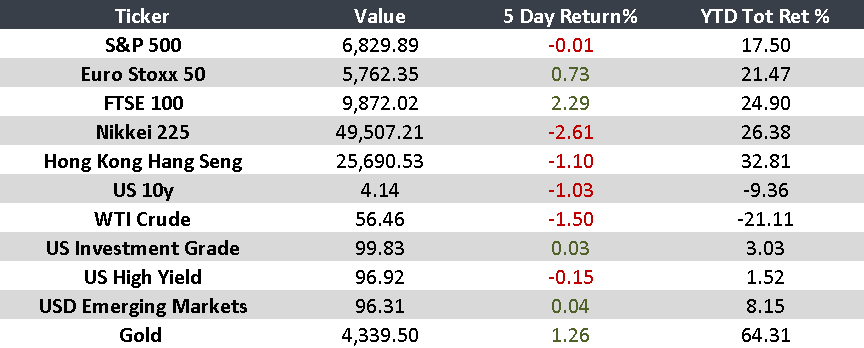
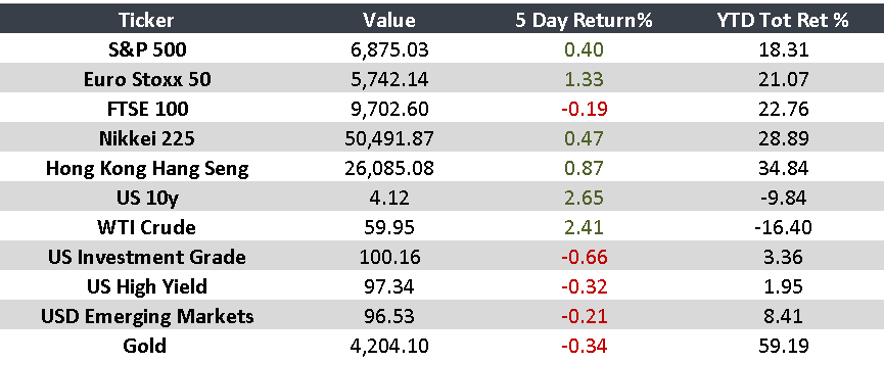
Returns as of market close on December 11. 

Fed: Mixed Signals After the Latest Rate Cut

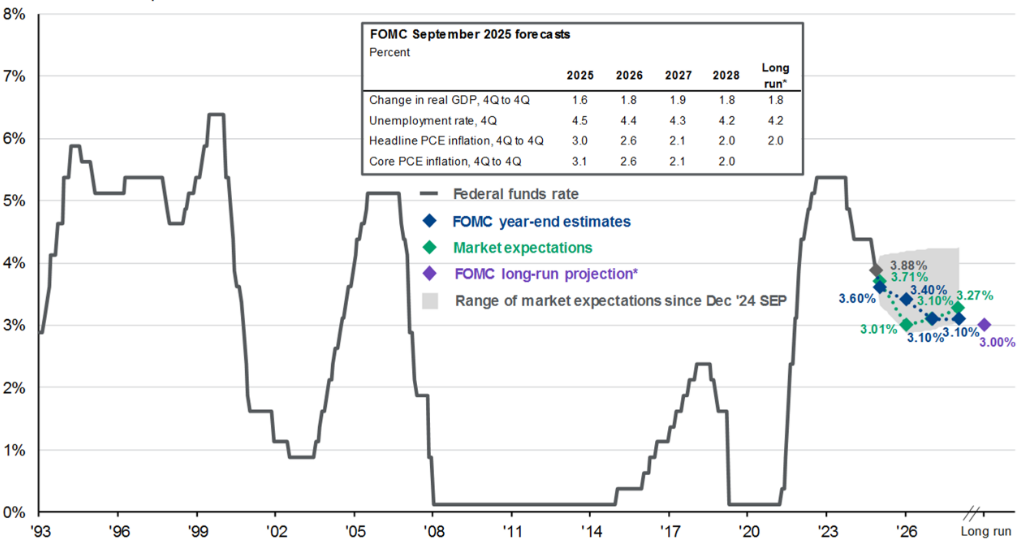
The Federal Reserve delivered its third consecutive rate cut, lowering the federal funds rate to a range of 3.50%–3.75%. While the move was widely anticipated, the accompanying statement revealed rising uncertainty about the policy path ahead. The committee showed an unusual split between members focused on labor-market weakness and those still concerned about persistent inflation pressures.

The updated dot plot, which reflects policymakers’ rate expectations, pointed to just one additional cut in 2026 and another in 2027. Although the projected path remained unchanged, it underscored diverging views within the committee regarding the appropriate level of interest rates over the medium term.

The latest rate cut confirms that the Fed maintains an accommodative bias, but the internal divisions suggest that the pace of future adjustments is likely to slow. In this environment, markets are expected to remain highly sensitive to incoming employment, inflation, and monetary policy expectation data throughout 2026.

Source: JP Morgan

Mixed signals: weak manufacturing, moderating labor data, and rising expectations of rate cuts 

Markets ended the week focused on the persistent weakness in global manufacturing activity and the continued loss of momentum in the U.S. labor market. In this environment, expectations for a potential interest rate cut before year-end strengthened. Europe and Asia showed mixed signals, while Latin America posted contrasting results across growth and income indicators. 

United States: 

  • Manufacturing contracted for the ninth consecutive month, while the services sector recorded its strongest expansion in nine months. 
  • Private employers cut 32,000 jobs, reinforcing expectations of a December rate cut, now priced with an 87% probability. 

Europe: 

  • The Bank of England reduced capital requirements for the first time since 2008 in an effort to stimulate lending. 
  • Eurozone inflation reached 2.2% year over year, with services remaining the main driver. 

Japan: 

  • The services sector maintained a solid pace of expansion in November, supported by rising new orders and improved business confidence. 

China: 

  • Manufacturing contracted for the eighth straight month, while services grew at their slowest pace in five months. 
  • Analysts expect additional expansionary measures to help sustain a growth target near 5% in 2026. 

Brazil: 

  • GDP grew 1.8% year over year in 3Q25, its weakest reading since 2022. 
  • Agriculture and industry remained the main contributors despite the slowdown. 

Mexico: 

  • Remittances fell 1.7% year over year in October, marking the smallest decline since April. 
  • The minimum wage will increase 13% in 2026 to 315.04 pesos per day, a cumulative rise of 150% since 2018. 

“Risk comes from not knowing what you’re doing.” — Warren Buffett 

Key Upcoming Events: 

  • United States: Employment data release — Dec 9 
  • United States: Federal Reserve monetary policy announcement — Dec 10 

Monitor

Is the Santa Claus Rally real?

A seasonal rally or just a myth? 

The “Santa Claus Rally” describes a historical pattern: markets tend to rise during the final days of December and early January. We analyze its consistency and what to expect heading into 2025. 

In the financial world, the “Santa Claus Rally” describes a historical pattern: markets tend to rise during the last five trading days of December and the first two of January. According to the Stock Trader’s Almanac, this phenomenon has occurred approximately 78%–80% of the time since 1972, with an average return of 1.3% to 1.4% for the S&P 500. 

Possible reasons range from lower trading volume as many institutional investors take time off, to a more optimistic emotional tone driven by the holidays, year-end bonuses, and portfolio adjustments like rebalancing or tax-loss harvesting. 

However, it doesn’t always happen. Over the past decade, the effect has been weaker, with average returns around 0.38%. Factors like inflation, elevated rates, geopolitical tensions, or economic surprises have completely negated this seasonal boost. 

Key Takeaways: 
✓ While the Santa Claus Rally has shown historical consistency, factors like elevated rates, inflation, and volatility limit its reliability as a strategy. If it happens, view it as an extra boost—not a basis for decision-making. 
 
✓ The Santa Claus Rally refers to the market uptick during the last five trading days of December and the first two trading days of January. 

Ponte en contacto con nosotros

Receive the best financial market news

Cookie Policy

We use our own and third party cookies to improve our services and show you advertising related to your preferences, by analyzing your browsing habits. By continuing, you confirm that you have read and accept this policy.