Weekly Summary

Persistent Inflation, Central Banks Under Pressure, and AI as the Bright Spot 

This week, markets were reminded that the path to monetary normalization is anything but linear. While inflation remains above target on multiple fronts, artificial intelligence continues to anchor investor optimism.


The Fed, ECB, and BoJ Face the Same Crossroads 

The week of August 24–28 was defined by mixed signals across the global economy. In the United States, Nvidia reaffirmed the strength of AI-driven demand, but PCE inflation at 3.7% kept the debate alive over whether the Fed will need to resume its rate-hiking cycle. U.S. GDP grew at a 1.5% annualized rate — a figure that speaks to resilience, but also to a slowdown that complicates the policy outlook. 

In Europe, the ECB is weighing a rate increase to 2.50% in September, with inflation hovering near 3% and expectations rising in the U.K. Japan faces a different dynamic: markets expect the Bank of Japan to raise its policy rate to 1.25% amid yen weakness and inflationary pressure, a move that could significantly increase the cost of servicing the country’s sovereign debt. In China, the government announced new liquidity measures to support domestic demand that continues to show signs of fragility. In Latin America, Brazil posted its lowest unemployment rate since December 2025, Mexico delivered solid GDP growth in Q2, and Argentina and Chile revived their cross-border mining treaty with an investment potential exceeding USD 20.7 billion. 

For investors, this week’s global environment reinforces the importance of closely tracking central bank decisions. The combination of persistent inflation and moderate growth leaves little room for error: a more hawkish tone from any of the three major central banks could trigger volatility. At the same time, the technology sector — driven by AI demand — continues to offer value opportunities amid macroeconomic uncertainty. 


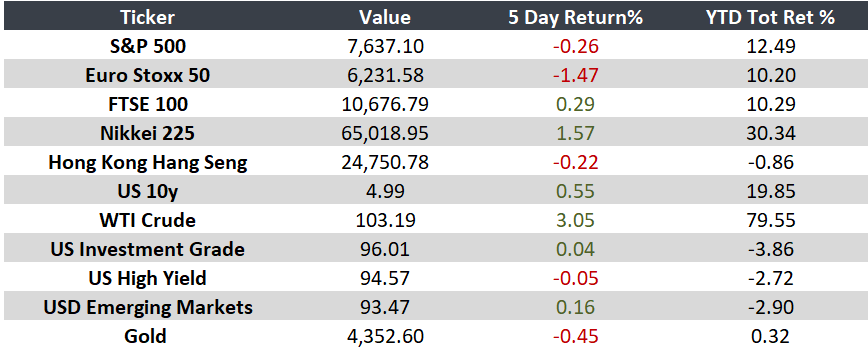
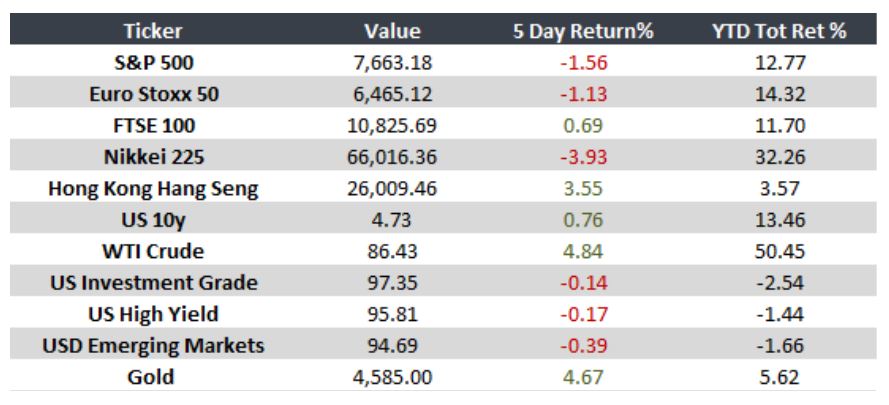
Monitor

Source: Macroeconomic data for the week of August 24–28, 2026. 

Global Weekly Outlook

Higher rates, inflationary pressures, and mixed growth signals shaped the week.

Markets experienced a more volatile week, with U.S. Treasury yields rising and inflationary pressures resurfacing. While the U.S. and Europe face elevated rates, Asia showed signs of slowing momentum.

  • The 30-year Treasury yield reached its highest level since 2007 amid mounting fiscal and geopolitical pressures. The Fed remains open to raising rates if inflation persists.

  • Inflation rose to 2.9% in both the Eurozone and the U.K., driven by energy prices. In contrast, investor confidence in Germany improved despite elevated energy costs.

  • GDP grew 0.3% quarter over quarter in Q2 but lost momentum amid weak domestic demand. Annual inflation rose to 1.9%, its highest level since December.

  • Industrial production growth slowed to 4.5% year over year, while retail sales rose just 0.6%, reflecting weak domestic demand and a sharp contraction in auto sales.

  • Economic activity grew 2.7% year over year in June, exceeding expectations. Growth was broad-based, with 12 of 15 sectors expanding and strong performance in fishing and mining.

  • The economy grew just 0.2% in Q2, showing signs of slowing momentum. Industry expanded, while services contracted amid a persistently high interest rate environment.
  • Inflation eased and GDP rebounded in Q2, although Banxico may keep rates elevated for longer. Tax revenues edged higher, while retail sales grew 2.7% year over year.

“The single greatest edge an investor can have is a long-term orientation.”
— Seth Klarman

Upcoming Events

  • United States: Employment-related data will be released — 08/25
  • United States: Preliminary Q2 GDP growth will be released — 08/26

Market Monitor

Indicative prices as of 10:00 AM EST

Inflation Steps Back, Markets Move Forward

This week’s U.S. inflation data gave markets exactly what they were looking for: confirmation that monetary policy could remain on hold in the near term.


U.S. inflation moderated as expected during the week of August 10–14, pushing major equity indices to new all-time highs. This reinforces the soft-landing narrative and reduces pressure on the Federal Reserve to act in the near term.


Beyond the U.S. border, the global picture offered important nuances. Europe showed resilience with solid second-quarter growth in both the U.K. and the Eurozone, while Asia continued to deliver mixed signals: Japan sees producer prices gradually easing, and China faces weak domestic demand despite moderating inflation. In Latin America, Brazil reported inflation within the central bank’s target range and solid consumer spending, while Mexico continues to navigate U.S. tariff pressure on its automotive sector, even as broader industrial activity surprised to the upside.


For investors, this week’s environment reinforces a risk-on posture, with equity markets leading the optimism. However, attention will need to shift to the Jackson Hole Symposium, where the Fed may deliver key signals about its monetary policy roadmap. Any tone more hawkish than expected could reverse some of the recent gains.

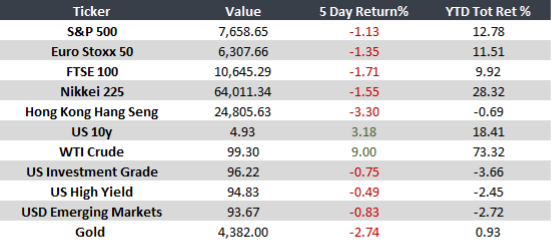
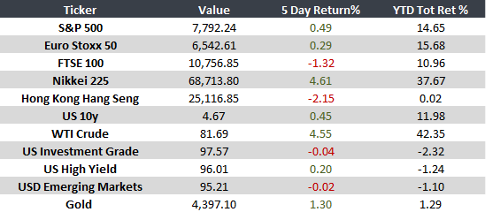
Monitor


Source: Macroeconomic data for the week of August 10–14, 2026.

Global Weekly Outlook 

Labor market softens while artificial intelligence continues to fuel corporate growth.

Markets navigated a week of mixed signals. While the U.S. labor market slowed more than expected, manufacturing activity and earnings season continued to benefit from investment in artificial intelligence. At the same time, Europe maintained moderate growth, Asia remained supported by trade, and Latin America continued to navigate a cautious monetary policy environment.

Employment came in weaker than expected, reinforcing expectations that the Fed will keep interest rates unchanged. Manufacturing activity and corporate earnings continue to show strength, driven by investment in artificial intelligence.

Producer price inflation continued to moderate, although consumer demand remained weak. Manufacturing showed modest improvement, supported by stronger exports and easing input costs.

Manufacturing recorded its seventh consecutive month of expansion, with the strongest production growth since 2014, fueled by robust AI-related demand.

Exports remained strong, supported by technology and AI-related demand, while manufacturing activity moderated, pointing to more balanced economic growth.

The renewal of the currency swap agreement with China strengthens external liquidity and provides additional financial support for bilateral trade.

The central bank lowered its benchmark interest rate while maintaining a cautious stance on inflation. Industrial activity continues to show signs of slowing.

Banxico kept its benchmark interest rate unchanged. Public investment and remittances continue to support economic activity despite ongoing global uncertainty.

“To earn the highest of returns that are realistically possible, you should invest with simplicity.”
— John Bogle

Upcoming events

  • In the United States, inflation data will be released 08/12
  • In the United States, PPI data will be released on 08/13

Market Monitor

Indicative prices as of 10:00 AM EST

Weekly Global Outlook

The Fed kept interest rates unchanged, earnings season remains strong, and major economies continue to deliver mixed economic signals.

Markets continue to balance a resilient economy with inflation that remains above target, limiting the pace of future rate cuts. Meanwhile, corporate earnings continue to outperform expectations, while several major economies posted stronger-than-expected growth.

  • The Federal Reserve left interest rates unchanged. While economic activity remains resilient, inflation continues to run above target, making near-term rate cuts less likely.

  • The Eurozone and Germany posted stronger-than-expected economic growth, supported by technology and exports. However, higher energy prices continue to keep inflation under pressure.

  • The Bank of Japan maintained its monetary policy stance while slightly improving its growth outlook. Meanwhile, the labor market continues to show remarkable resilience.

  • Manufacturing activity contracted again, reflecting weaker domestic and external demand and reinforcing signs that the country’s economic recovery continues to lose momentum.

  • The IMF acknowledged improving confidence in Argentina’s macroeconomic outlook while maintaining caution regarding fiscal challenges and political uncertainty ahead of the 2027 elections.

  • Inflation continued to moderate, supported by lower food prices, providing additional room for monetary policy in the coming months.

  • Mexico’s economy exceeded expectations, driven by strong export growth that offset weak domestic demand and supported second-quarter economic activity.

“Never invest in a company without understanding its finances.”
— Peter Lynch

Upcoming Events

  • U.S. ISM Manufacturing PMI — August 3
  • U.S. Nonfarm Payrolls — August 7


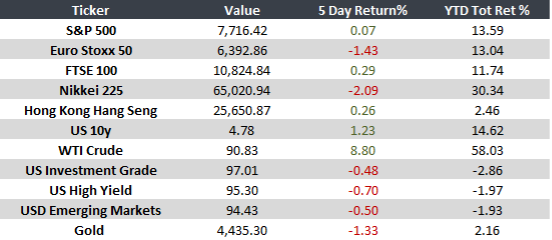
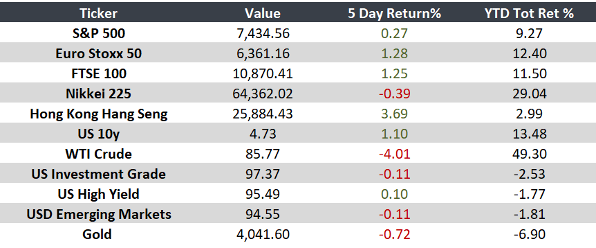
Market Monitor

Indicative prices as of 10:00 AM EST

Weekly Global Outlook 

Tariffs, corporate earnings, and monetary policy shaped market direction.

Markets navigated a week marked by new trade measures, geopolitical tensions, and mixed corporate earnings. While inflation continues to ease across several economies, uncertainty surrounding global trade and economic growth is keeping investors cautious.

  • Higher oil prices, new tariffs, and rising Treasury yields increased market caution. Earnings season continues with investors focused on artificial intelligence infrastructure spending.

  • The European Central Bank kept interest rates unchanged while inflation continued to moderate. Business confidence improved, although signs of industrial weakness persist.

  • Inflation reached its highest level since December, while the trade balance posted a deficit driven by higher energy imports and solid domestic demand.

  • The People’s Bank of China kept its benchmark lending rates unchanged for the fourteenth consecutive month, prioritizing stability amid weakness in the property sector and ongoing geopolitical uncertainty.

  • The economy posted modest annual growth, supported by the mining sector, although monthly activity continued to reflect weakness in manufacturing and trade.

  • New U.S. tariffs increased uncertainty for Brazilian exports, while several industries are already anticipating negative employment effects.

  • Inflation continued to ease, while economic activity delivered mixed signals. The new U.S. tariff is expected to have a limited impact thanks to USMCA exemptions.

“Buying’s easier, selling’s hard — it’s hard to know when to get out.”
— Seth Klarman

Key Upcoming Events

  • In the United States, the FED’s monetary policy decision will be released 07/29
  • In the United States, Q2 GDP growth data will be released 07/30

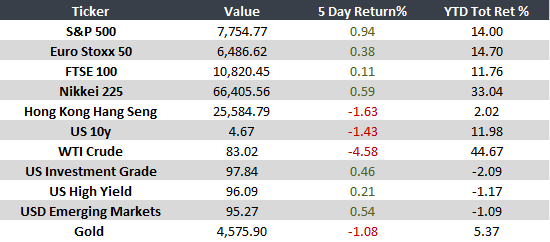
Monitor:

Note: Returns as of 10 AM EST

Weekly Global Outlook 

Lower inflation, corporate earnings, and uneven growth signals shaped the week.

Markets assessed the start of earnings season alongside easing inflation in the United States. However, geopolitical tensions and weaker activity and investment continue to create an uneven global economic environment.

  • Inflation eased and the labor market remained resilient. Early corporate earnings exceeded expectations, although technology-sector volatility and geopolitical tensions weighed on markets.

  • Eurozone inflation continued to decline, but industrial production remained weak. The United Kingdom posted moderate growth, supported by the services sector.

  • Industrial production edged higher during the month but declined year over year due to weakness in machinery, pointing to a still-fragile recovery.

  • GDP growth slowed due to weak consumer spending and lower investment. Exports rebounded strongly, supported by demand related to artificial intelligence.

  • Annual inflation increased, although the monthly pace moderated. Tourism, housing, and regulated services continued to drive price pressures.

  • Retail sales and the services sector posted limited growth. Weakness in transportation confirmed a moderate economic activity environment.

  • Formal employment and manufacturing payrolls continued to weaken, while private consumption remained resilient, supported by real wage growth, remittances, and low unemployment.

“Investing is the intersection of economics and psychology.”
— Phil Town

KEY UPCOMING EVENTS

  • In the United States, employment related data will be released 07/21
  • In the United States, manufacturing PMI will be released on 07/24

Monitor:

Note: Returns as of 10 AM ET.

Global Weekly Outlook 

Markets combined lower volatility with mixed signals on growth and inflation.

Markets remained relatively stable, although challenges related to inflation, international trade, and monetary policy persist. While the United States and Europe continue to show resilience across several indicators, Asia and Latin America face more specific economic headwinds.

  • Markets posted modest gains despite continued volatility in oil prices. The Fed remains firmly data-dependent, while the trade deficit widened and services activity continued to lose momentum.

  • Consumer spending continues to recover and Germany’s external trade improved. However, higher producer prices indicate that inflationary pressures have not fully subsided.

  • Producer price inflation remains elevated, although the monthly pace of increase moderated, suggesting a gradual easing in cost pressures.

  • Consumer inflation continued to soften, while producer prices posted their strongest increase in several years, reflecting rising costs across the industrial sector.

  • The government is seeking to secure debt financing through domestic and multilateral sources, prioritizing lower borrowing costs before returning to international capital markets.

  • Inflation continued to moderate thanks to lower food and housing costs, although energy prices remain a significant source of inflationary pressure.

  • Inflation fell to its lowest level since 2020, while investment showed signs of recovery. However, uncertainty surrounding trade relations with the United States continues to weigh on the automotive sector.

“It’s not how much money you make, but how much money you keep, how hard it works for you, and how many generations you keep it for.”

— Robert Kiyosaki

Key Upcoming Events

  • In the United States, June inflation data will be released 07/14
  • In the United States, June PPI will be released 07/15

Monitor:

Note: Returns as of 10 AM ET

Weekly Global Overview 

Global growth continues to show mixed signals between resilient consumption and moderating economic activity.

Markets entered July with lighter trading activity due to the U.S. Independence Day holiday, while economic indicators pointed to a gradual slowdown in global growth. Consumption remains resilient across several regions, although challenges related to trade, manufacturing, and industrial activity persist.

United States

  • Markets ended the week on a positive note despite signs of moderation in labor markets and manufacturing activity. Consumption remains solid, although the trade deficit reached its highest level in more than a year.

Europe

  • Inflation continues to moderate thanks to lower energy costs. Consumption remains resilient, although signs of industrial weakness and slower growth in the United Kingdom persist.

Japan

  • Retail sales surprised to the upside, supported by wage growth, while industrial production continues a gradual, albeit fragile, recovery.

China

  • The manufacturing PMI recorded its third consecutive month of expansion, driven by technology exports and artificial intelligence-related demand, despite weak domestic consumption.

Argentina

  • Economic activity continues to post positive annual growth, albeit at a slower pace, supported by agriculture and mining.

Brazil

  • Producer prices faced less pressure due to lower food and mining costs, partially offsetting increases in other industrial sectors.

Mexico

  • Manufacturing activity and remittances continue to support economic growth, while concerns over trade and tax revenue collection are increasing.

“Compound interest is the eighth wonder of the world. He who understands it, earns it. He who doesn’t, pays it.” — Albert Einstein

KEY UPCOMING EVENTS

  • In the United States, the Services PMI will be released on 07/06
  • In the United States, employment-related data will be released on 07/09

Monitor:

Note: Returns as of July 2 at closing

Markets Between Monetary Caution and Slowing Growth 

Week of June 15–19

Central banks remain cautious as the global economy shows diverging signals

The week was marked by monetary policy decisions, persistent inflationary pressures, and mixed growth signals. While some central banks maintained a cautious stance, economic activity reflected contrasting trends across regions as investors continued to monitor interest rate and inflation developments.

The Fed kept rates unchanged at 3.5%–3.75%, removed its easing bias, and projected a median policy rate of 3.8% for 2026. Consumer spending surprised to the upside, while housing and manufacturing showed weakness.

The Bank of England held rates at 3.75%, and Eurozone inflation remained at 3.2%. Germany showed improving economic sentiment, although the construction sector remains under pressure.

The BoJ raised its policy rate to 1.0%, the highest level since 1995. Inflation increased modestly, while exports rose 17%, driven by semiconductors and AI-related technology.

Consumer activity showed signs of weakness, with declines in retail sales and urban investment. However, industrial production and labor market indicators pointed to greater stability.

Consumer confidence rose 6.4% in June, supported by improved expectations and a recovery in sentiment toward durable goods and real estate.

Brazil’s central bank lowered its policy rate to 14.25% but warned that inflation remains a key risk. Retail sales declined, reflecting softer economic activity.

Mexico, the United States, and Canada will formally begin the USMCA review process on July 1, marking a key step for North American economic integration.

“If a business does well, the stock eventually follows.” — Warren Buffett

Key Upcoming Events

  • In the United States, employment related data will be released 06/23
  • In the United States, Q1 final growth data will be released 06/25

Monitor:

Note: Returns as of June 18th at closing.

Ponte en contacto con nosotros

Receive the best financial market news

Cookie Policy

We use our own and third party cookies to improve our services and show you advertising related to your preferences, by analyzing your browsing habits. By continuing, you confirm that you have read and accept this policy.