Weekly Summary

Weekly Global Outlook

The Fed kept interest rates unchanged, earnings season remains strong, and major economies continue to deliver mixed economic signals.

Markets continue to balance a resilient economy with inflation that remains above target, limiting the pace of future rate cuts. Meanwhile, corporate earnings continue to outperform expectations, while several major economies posted stronger-than-expected growth.

  • The Federal Reserve left interest rates unchanged. While economic activity remains resilient, inflation continues to run above target, making near-term rate cuts less likely.

  • The Eurozone and Germany posted stronger-than-expected economic growth, supported by technology and exports. However, higher energy prices continue to keep inflation under pressure.

  • The Bank of Japan maintained its monetary policy stance while slightly improving its growth outlook. Meanwhile, the labor market continues to show remarkable resilience.

  • Manufacturing activity contracted again, reflecting weaker domestic and external demand and reinforcing signs that the country’s economic recovery continues to lose momentum.

  • The IMF acknowledged improving confidence in Argentina’s macroeconomic outlook while maintaining caution regarding fiscal challenges and political uncertainty ahead of the 2027 elections.

  • Inflation continued to moderate, supported by lower food prices, providing additional room for monetary policy in the coming months.

  • Mexico’s economy exceeded expectations, driven by strong export growth that offset weak domestic demand and supported second-quarter economic activity.

“Never invest in a company without understanding its finances.”
— Peter Lynch

Upcoming Events

  • U.S. ISM Manufacturing PMI — August 3
  • U.S. Nonfarm Payrolls — August 7


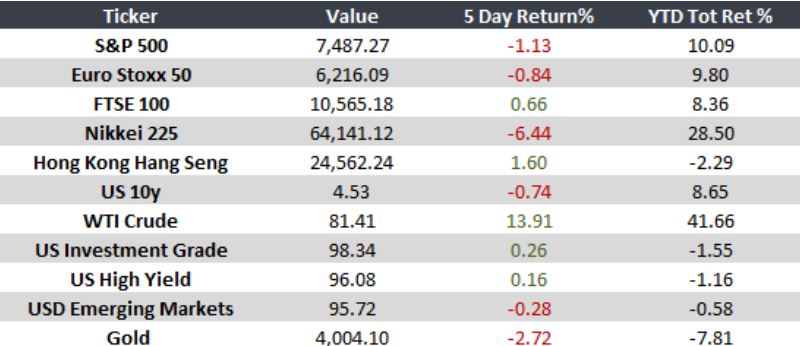
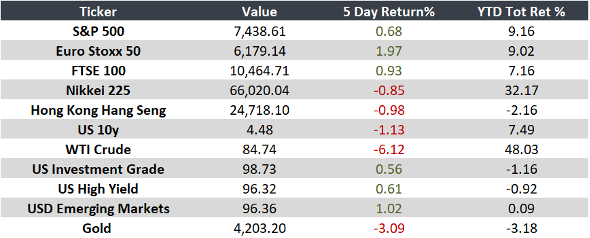
Market Monitor
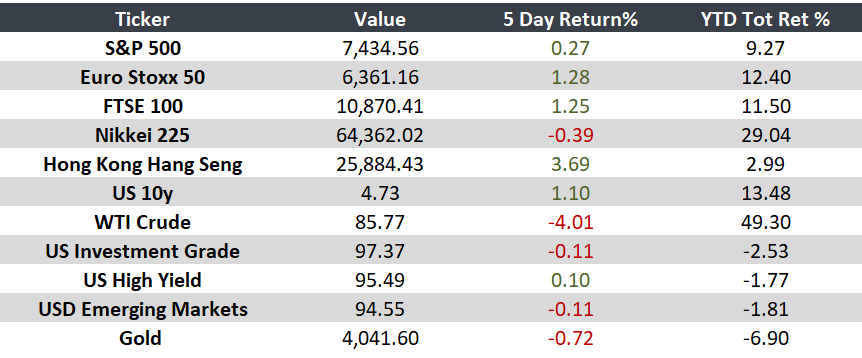
Indicative prices as of 10:00 AM EST
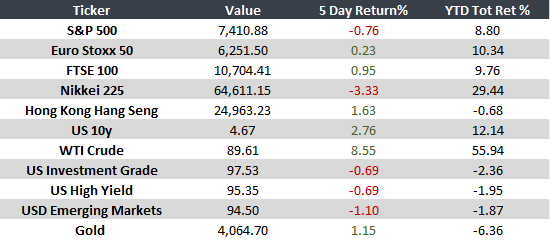
Weekly Global Outlook 

Tariffs, corporate earnings, and monetary policy shaped market direction.

Markets navigated a week marked by new trade measures, geopolitical tensions, and mixed corporate earnings. While inflation continues to ease across several economies, uncertainty surrounding global trade and economic growth is keeping investors cautious.

  • Higher oil prices, new tariffs, and rising Treasury yields increased market caution. Earnings season continues with investors focused on artificial intelligence infrastructure spending.

  • The European Central Bank kept interest rates unchanged while inflation continued to moderate. Business confidence improved, although signs of industrial weakness persist.

  • Inflation reached its highest level since December, while the trade balance posted a deficit driven by higher energy imports and solid domestic demand.

  • The People’s Bank of China kept its benchmark lending rates unchanged for the fourteenth consecutive month, prioritizing stability amid weakness in the property sector and ongoing geopolitical uncertainty.

  • The economy posted modest annual growth, supported by the mining sector, although monthly activity continued to reflect weakness in manufacturing and trade.

  • New U.S. tariffs increased uncertainty for Brazilian exports, while several industries are already anticipating negative employment effects.

  • Inflation continued to ease, while economic activity delivered mixed signals. The new U.S. tariff is expected to have a limited impact thanks to USMCA exemptions.

“Buying’s easier, selling’s hard — it’s hard to know when to get out.”
— Seth Klarman

Key Upcoming Events

  • In the United States, the FED’s monetary policy decision will be released 07/29
  • In the United States, Q2 GDP growth data will be released 07/30

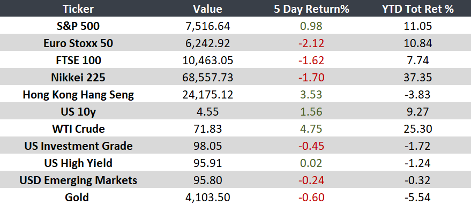
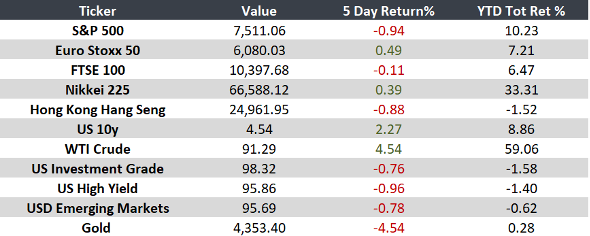
Monitor:

Note: Returns as of 10 AM EST

Weekly Global Outlook 

Lower inflation, corporate earnings, and uneven growth signals shaped the week.

Markets assessed the start of earnings season alongside easing inflation in the United States. However, geopolitical tensions and weaker activity and investment continue to create an uneven global economic environment.

  • Inflation eased and the labor market remained resilient. Early corporate earnings exceeded expectations, although technology-sector volatility and geopolitical tensions weighed on markets.

  • Eurozone inflation continued to decline, but industrial production remained weak. The United Kingdom posted moderate growth, supported by the services sector.

  • Industrial production edged higher during the month but declined year over year due to weakness in machinery, pointing to a still-fragile recovery.

  • GDP growth slowed due to weak consumer spending and lower investment. Exports rebounded strongly, supported by demand related to artificial intelligence.

  • Annual inflation increased, although the monthly pace moderated. Tourism, housing, and regulated services continued to drive price pressures.

  • Retail sales and the services sector posted limited growth. Weakness in transportation confirmed a moderate economic activity environment.

  • Formal employment and manufacturing payrolls continued to weaken, while private consumption remained resilient, supported by real wage growth, remittances, and low unemployment.

“Investing is the intersection of economics and psychology.”
— Phil Town

KEY UPCOMING EVENTS

  • In the United States, employment related data will be released 07/21
  • In the United States, manufacturing PMI will be released on 07/24

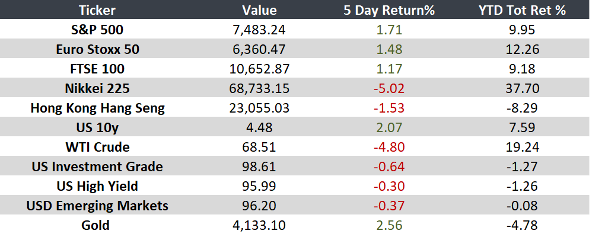
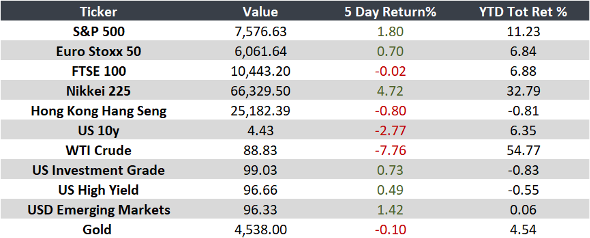
Monitor:

Note: Returns as of 10 AM ET.

Global Weekly Outlook 

Markets combined lower volatility with mixed signals on growth and inflation.

Markets remained relatively stable, although challenges related to inflation, international trade, and monetary policy persist. While the United States and Europe continue to show resilience across several indicators, Asia and Latin America face more specific economic headwinds.

  • Markets posted modest gains despite continued volatility in oil prices. The Fed remains firmly data-dependent, while the trade deficit widened and services activity continued to lose momentum.

  • Consumer spending continues to recover and Germany’s external trade improved. However, higher producer prices indicate that inflationary pressures have not fully subsided.

  • Producer price inflation remains elevated, although the monthly pace of increase moderated, suggesting a gradual easing in cost pressures.

  • Consumer inflation continued to soften, while producer prices posted their strongest increase in several years, reflecting rising costs across the industrial sector.

  • The government is seeking to secure debt financing through domestic and multilateral sources, prioritizing lower borrowing costs before returning to international capital markets.

  • Inflation continued to moderate thanks to lower food and housing costs, although energy prices remain a significant source of inflationary pressure.

  • Inflation fell to its lowest level since 2020, while investment showed signs of recovery. However, uncertainty surrounding trade relations with the United States continues to weigh on the automotive sector.

“It’s not how much money you make, but how much money you keep, how hard it works for you, and how many generations you keep it for.”

— Robert Kiyosaki

Key Upcoming Events

  • In the United States, June inflation data will be released 07/14
  • In the United States, June PPI will be released 07/15

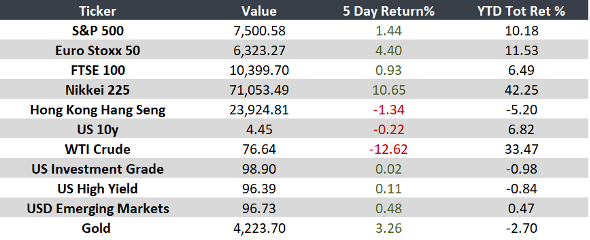
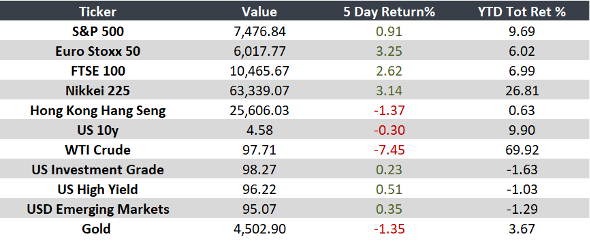
Monitor:

Note: Returns as of 10 AM ET

Weekly Global Overview 

Global growth continues to show mixed signals between resilient consumption and moderating economic activity.

Markets entered July with lighter trading activity due to the U.S. Independence Day holiday, while economic indicators pointed to a gradual slowdown in global growth. Consumption remains resilient across several regions, although challenges related to trade, manufacturing, and industrial activity persist.

United States

  • Markets ended the week on a positive note despite signs of moderation in labor markets and manufacturing activity. Consumption remains solid, although the trade deficit reached its highest level in more than a year.

Europe

  • Inflation continues to moderate thanks to lower energy costs. Consumption remains resilient, although signs of industrial weakness and slower growth in the United Kingdom persist.

Japan

  • Retail sales surprised to the upside, supported by wage growth, while industrial production continues a gradual, albeit fragile, recovery.

China

  • The manufacturing PMI recorded its third consecutive month of expansion, driven by technology exports and artificial intelligence-related demand, despite weak domestic consumption.

Argentina

  • Economic activity continues to post positive annual growth, albeit at a slower pace, supported by agriculture and mining.

Brazil

  • Producer prices faced less pressure due to lower food and mining costs, partially offsetting increases in other industrial sectors.

Mexico

  • Manufacturing activity and remittances continue to support economic growth, while concerns over trade and tax revenue collection are increasing.

“Compound interest is the eighth wonder of the world. He who understands it, earns it. He who doesn’t, pays it.” — Albert Einstein

KEY UPCOMING EVENTS

  • In the United States, the Services PMI will be released on 07/06
  • In the United States, employment-related data will be released on 07/09

Monitor:

Note: Returns as of July 2 at closing

Markets Between Monetary Caution and Slowing Growth 

Week of June 15–19

Central banks remain cautious as the global economy shows diverging signals

The week was marked by monetary policy decisions, persistent inflationary pressures, and mixed growth signals. While some central banks maintained a cautious stance, economic activity reflected contrasting trends across regions as investors continued to monitor interest rate and inflation developments.

The Fed kept rates unchanged at 3.5%–3.75%, removed its easing bias, and projected a median policy rate of 3.8% for 2026. Consumer spending surprised to the upside, while housing and manufacturing showed weakness.

The Bank of England held rates at 3.75%, and Eurozone inflation remained at 3.2%. Germany showed improving economic sentiment, although the construction sector remains under pressure.

The BoJ raised its policy rate to 1.0%, the highest level since 1995. Inflation increased modestly, while exports rose 17%, driven by semiconductors and AI-related technology.

Consumer activity showed signs of weakness, with declines in retail sales and urban investment. However, industrial production and labor market indicators pointed to greater stability.

Consumer confidence rose 6.4% in June, supported by improved expectations and a recovery in sentiment toward durable goods and real estate.

Brazil’s central bank lowered its policy rate to 14.25% but warned that inflation remains a key risk. Retail sales declined, reflecting softer economic activity.

Mexico, the United States, and Canada will formally begin the USMCA review process on July 1, marking a key step for North American economic integration.

“If a business does well, the stock eventually follows.” — Warren Buffett

Key Upcoming Events

  • In the United States, employment related data will be released 06/23
  • In the United States, Q1 final growth data will be released 06/25

Monitor:

Note: Returns as of June 18th at closing.

Markets Between Resilience and Inflationary Pressure 

Week of June 8–12

Persistent inflation and geopolitical tensions continue to shape markets

The week was marked by higher inflation across several economies, energy-related pressures stemming from the Middle East conflict, and mixed growth signals. Despite these challenges, some sectors continue to demonstrate resilience, while investors remain focused on monetary policy decisions.

Inflation rose to 4.2%, while PPI reached its highest level since 2022. However, home sales remained strong, and SpaceX completed the largest IPO in history.

The ECB raised rates to 2.25% and revised its inflation outlook higher. Germany saw inflation moderate, while the UK recorded its first economic contraction since August.

GDP exceeded expectations, supported by consumer spending and exports. However, producer prices rose 6.3%, reflecting the impact of higher energy costs.

Inflation remained stable, but producer prices reached their highest level since 2022. Energy and commodity costs continue to pressure industrial margins.

Inflation edged up to 33.6% year-over-year in May. Despite the increase, it remains well below levels seen in recent years.

Inflation reached 4.72%, exceeding expectations and marking its highest level since September, driven by food and energy prices.

Inflation returned to Banxico’s target range and producer prices moderated. However, automotive production declined, although exports continued to grow.

“You make most of your money in a bear market, you just don’t realize it at the time.” — Shelby Cullom Davis

Key Upcoming Events

  • In the United States, industrial production data will be released 06/15
  • In the United States, the FED monetary policy decision will be released on 06/17

Monitor:

Note: Returns as of 10 AM ET.

Weekly Global Outlook

Markets remain resilient despite inflationary pressures and global challenges

The global economy continues to display mixed signals. While the United States remains supported by strong employment and economic activity, Europe faces rising inflationary pressures and Asia presents a contrast between recovering demand and slowing industrial activity. Investors remain focused on the path of interest rates and the performance of corporate earnings.

United States

Markets pulled back after reaching record highs as bond yields moved higher. Employment and economic activity exceeded expectations, while investor appetite for AI and technology infrastructure companies remained strong.

Europe

Eurozone inflation reached 3.2%, driven by higher energy prices. Manufacturing continues to expand modestly, although elevated costs and softer new orders are weighing on momentum.

Japan

Manufacturing and services activity showed signs of slowing. Input costs continue to rise, while both domestic and external demand are gradually losing momentum.

China

Manufacturing growth moderated but exceeded expectations. Services activity posted its strongest performance since February, supported by improving domestic demand.

Argentina

The government will move forward with its application to join the CPTPP, reinforcing its trade liberalization strategy and deeper integration into global markets.

Brazil

Manufacturing activity contracted due to weaker demand and supply-chain disruptions. However, industrial production maintained solid year-over-year growth, highlighting the sector’s resilience.

Mexico

Lower tax revenues are increasing pressure on fiscal deficit targets. Meanwhile, remittances continue to grow, while fixed investment remains on a prolonged weak trend.

“Bull markets are born on pessimism, grow on skepticism, mature on optimism, and die on euphoria.” — Sir John Templeton

KEY UPCOMING EVENTS

  • In the United States, inflation data (CPI) will be released 06/10
  • In the United States, PPI will be released 06/11

Monitor:

Note: Returns as of 10 AM ET.

Global Weekly Overview

Markets remain resilient despite ongoing inflationary and geopolitical challenges

Markets ended the week on a more constructive note, supported by moderating oil prices and strong corporate earnings. However, inflation remains above central bank targets, while geopolitical tensions continue to shape the global economic outlook.

United States

Markets advanced, supported by lower oil prices and S&P 500 earnings growth of 28.4%, the strongest pace since 2021. Inflation remains elevated, while consumer confidence continues to face pressure.

Europe

The ECB remains cautious amid still-elevated inflation. Although consumer confidence improved, economic sentiment remains weak and core inflation continues to run above target.

Japan

Retail sales and employment exceeded expectations. Consumption remains resilient, supported by government stimulus measures and a strong labor market.

China

Industrial profits increased 24.7%, driven by technology, electronics, and energy, reflecting a more favorable recovery in strategic sectors.


Argentina

Inflation expectations continue to moderate. Authorities anticipate monthly inflation below April levels, easing concerns over exchange-rate pressures.

Brazil

GDP exceeded expectations, supported by investment and consumer spending. However, producer prices continue to reflect pressures stemming from the global energy environment.

Mexico

Banxico lowered its 2026 growth forecast. Nevertheless, exports and foreign direct investment reached record levels, supporting economic activity.

“Markets can remain irrational longer than you can remain solvent.” — John Maynard Keynes

KEY UPCOMING EVENTS

  • In the United States, manufacturing PMI will be released 06/01
  • In the United States, nonfarm payrolls will be released on 06/05

Monitor:

Note: Returns as of 10 AM ET.

Global Weekly Overview 

A week marked by inflation pressures, rising rates, and mixed growth signals

Markets are facing a more restrictive environment, with persistent inflationary pressures and rising interest rates. While some economies show resilience, others reflect a slowdown, amid ongoing geopolitical risks.

United States

  • Fed Minutes point to potential rate hikes.
  • 30-year yields surpass 5%.
  • Earnings grow ~28%, but housing weakens.
  • Labor market remains resilient.

Europe

  • Eurozone inflation rises to 3.0% driven by energy.
  • UK inflation moderates, but unemployment increases.
  • Germany grows in line with expectations, with rising cost pressures.

Japan

  • GDP exceeds expectations, but energy costs threaten growth.
  • Inflation falls to 1.4%, remaining below the central bank’s target.

China

  • Retail sales and industrial production slow.
  • Weak domestic demand reflects softer consumption and manufacturing momentum.

Argentina

  • Economic activity rebounds to 5.5%, reversing the previous contraction and signaling recovery.

Brazil

  • Economic activity declines monthly but maintains 3.1% annual growth, reflecting partial resilience.

Mexico

  • Moody’s downgrades rating to Baa3.
  • Growth remains moderate, supported by services and easing inflation.

“Be fearful when others are greedy. Be greedy when others are fearful.” — Warren Buffett

KEY UPCOMING EVENTS

  • In the United States, markets will remain closed for Memorial Day 05/25
  • In the United States, employment related data will be released 05/27

Monitor:

Note: Returns as of 10 AM ET.

Source: JP Morgan

Ponte en contacto con nosotros

Receive the best financial market news

Cookie Policy

We use our own and third party cookies to improve our services and show you advertising related to your preferences, by analyzing your browsing habits. By continuing, you confirm that you have read and accept this policy.