Jacobo Taurel

Global Outlook

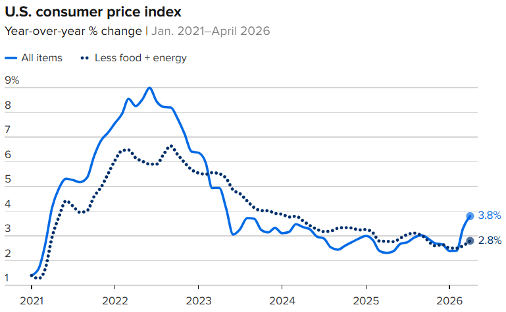
April’s inflation data in the U.S. presents a mixed picture: rising prices alongside a consumer that, for now, is holding firm.

U.S. inflation reaches highs while retail holds steady

U.S. inflation accelerated to 3.8% year-over-year in April, its highest level since May 2023. While the energy sector drove much of the increase, core inflation also rose to 2.8%, remaining above the Federal Reserve’s target.

Despite this environment and a slight decline in real wages, consumer spending remains notably resilient. The retail sector added 22,000 jobs during the month, reflecting strong business confidence amid sustained demand.

Persistent inflation complicates the Federal Reserve’s outlook. However, labor market resilience and continued hiring in retail suggest that consumption is, for now, cushioning the impact of higher fuel costs and geopolitical tensions.

Source: Bureau of Labor Statistics
Global Weekly Overview

A week marked by inflation pressures and slowing activity

Recent data point to a moderate growth environment with persistent cost pressures. Inflation driven by energy and geopolitical tensions continues to shape monetary policy decisions globally.

  • Strong earnings (83% beating estimates) drive profit growth to ~23%.
  • Employment exceeds expectations but is slowing.
  • PMI signals rising cost pressures that could pass through to inflation.

  • Industrial costs remain elevated and services PMI drops to a 62-month low.
  • In Germany, weakness in manufacturing and services increases recession risks.

  • Services activity slows, while central bank minutes suggest potential rate hikes.
  • Energy shocks are raising inflation risks and pressure on exports.

  • Composite PMI improves on stronger demand, but input costs reach their highest levels since 2022, pressuring margins and growth sustainability.

  • Industrial activity rises 5.0% year-over-year, driven by chemicals. However, sectors such as machinery and textiles remain in contraction.

  • Industrial production rebounds 4.3%, reflecting the positive impact of rate cuts despite a more challenging global environment.

  • Banxico cuts rates to 6.50% and inflation slows.
  • Investment falls 4.2%, signaling weaker momentum and pressure on future growth.

“Time is your friend, impulse is your enemy.” — John Bogle

KEY UPCOMING EVENTS

  • In the United States, Inflation data will be released — 05/12
  • In the United States, PPI data will be released — 05/13

Monitor:

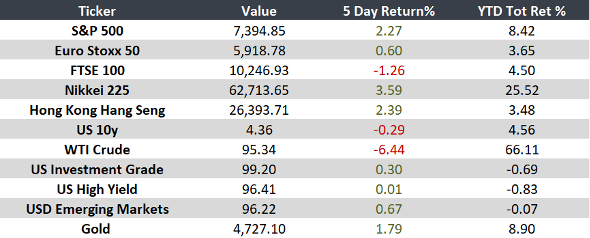
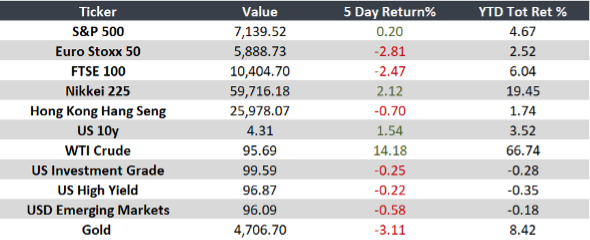
Note: Returns as of 10 AM ET.

Inside Blackstone’s Platinum Circle: Key Takeaways for Activest Clients

A few weeks ago, I attended Blackstone’s Platinum Circle gathering in New York — an exclusive event bringing together a select group of the nation’s top Registered Investment Advisors to discuss the most pressing issues in investment management today. Topics ranged from the impact of geopolitical conflicts on markets to the accelerating rise of artificial intelligence. The conference offered invaluable insights into the dynamics of the current financial landscape and how Activest can best navigate an ever-shifting environment on behalf of our clients.

The full-day program covered a broad range of themes: a constructive macroeconomic outlook, continued conviction in physical assets, selective opportunities in real estate, private equity and infrastructure, and a strong preference for evergreen fund structures. Key speakers, including Jon Gray and Steve Schwarzman, emphasized underwriting discipline, inflation linkage in infrastructure contracts, and sound portfolio construction principles.

Macro and Cross-Asset Views

A central message from the conference was one of cautious optimism. Inflation is broadly easing, though oil remains a near-term source of upside pressure, and the cost of capital appears to be stabilizing. Speakers were clear that geopolitical shocks — however alarming — have historically not derailed markets over the long term. As one speaker noted, markets have weathered more than 22 wars and have always rebounded.

One speaker offered a line that stuck with me as a simple but powerful reminder about long-term discipline: “Your portfolio is like a bar of soap. The more you touch it, the smaller it gets.” Less turnover, better compounding. It’s a principle we take seriously at Activest.

Artificial intelligence is expected to increase dispersion and selectivity across sectors, pressuring some valuations without necessarily decimating industries. Meanwhile, investment in digital infrastructure continues to accelerate, with power supply emerging as a critical constraint — reinforcing the importance of infrastructure exposure within a well-diversified portfolio.

Real Assets and Real Estate

Real estate generated significant discussion throughout the day. Speakers were clear-eyed about its cyclical nature: values can compress on discount-rate moves even when underlying cash flows remain intact. One striking data point — the cost to purchase a home is now 30% higher than renting, and the median age of first-time homebuyers has risen from 31 to 38. This dynamic strongly favors multifamily rental investments, particularly in Sun Belt markets.

In retail, the lack of new construction over recent years has created meaningful scarcity. With demand for retail services growing at roughly 3% per year, that supply constraint could translate into real expansion opportunities — especially for properties with near-term lease expirations.

Self-storage was highlighted as another attractive sector, driven by its close ties to mobility and life-transition dynamics. Data centers, meanwhile, emerged as the clear standout of the real estate conversation. Occupancy rates are running near 99%, and estimated demand for computing power in the U.S. stands at 200 gigawatts — far exceeding current capacity. The opportunity here is substantial.

Office space appears to have bottomed, though speakers stopped short of calling it a compelling opportunity at this stage.

Public Equity, Private Markets, and the Case for Diversification

Public equity valuations remain elevated — approximately 15x free cash flow — implying forward returns in the mid-single to low-double digit range. Private market valuations, while also above historical averages at roughly 12x free cash flow, remain meaningfully lower than their public counterparts, presenting a relative opportunity for patient, long-term investors.

A recurring theme across multiple sessions was the importance of broad diversification in achieving stable, durable returns. One speaker put it simply: “Concentration makes money. Diversification preserves it.”

Private markets are increasingly gravitating toward evergreen structures, which offer income generation, diversification, and more streamlined access than traditional drawdown models. They also simplify performance measurement — capital is deployed as a lump sum rather than through unpredictable capital calls, making it easier to track and evaluate outcomes.

Looking Ahead

In an ever-shifting financial landscape, staying close to the world’s leading asset managers isn’t a luxury — it’s a responsibility we take seriously on behalf of our clients. Over the years, Activest has cultivated deep relationships with top-tier managers globally, and events like Blackstone’s Platinum Circle give us a front-row seat to the thinking that shapes markets. These conversations directly inform how we position portfolios and evaluate opportunities across asset classes.

We look forward to sharing more of these insights with you as the year unfolds.

Infrastructure 

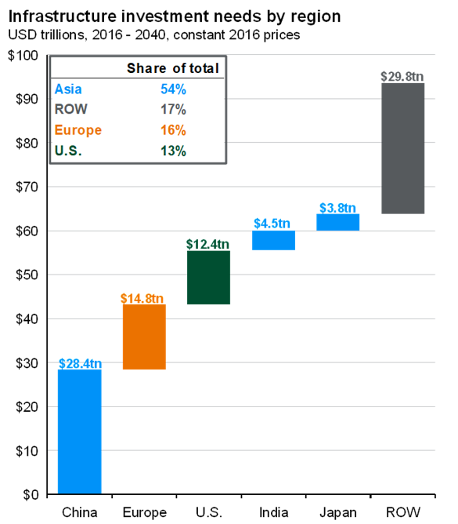
Infrastructure is one of the fastest-growing asset classes within private markets. Understanding what drives it and how it generates value is the first step in evaluating its role in a portfolio.

Fundamentals of an asset class built for the long term

Infrastructure encompasses essential assets such as energy, transportation, and digital networks, whose central characteristic is the generation of stable and predictable income over time. Unlike other asset classes, its value does not depend on short-term economic cycles, but on the structural demand for basic services.

In recent years, trends such as the energy transition and digitalization have expanded the universe of available opportunities, attracting institutional capital toward projects with long investment horizons.

However, the current environment presents important nuances: while fundraising has rebounded, it remains concentrated primarily in larger funds. Deal activity, meanwhile, faces pressure from lower transaction volumes.

Source: JP Morgan

Markets: Stability with mixed signals

Stable rates, persistent inflation, and uneven growth define the week

Markets reflect stability in monetary policy, but with increasing divergence in growth and inflation. The geopolitical backdrop continues to pressure expectations and limit global economic visibility.

United States

The Fed held rates at 3.5%–3.75% with an 8–4 split, the largest since 1992. GDP grew 2.0%, driven by AI investment and government spending, but consumption is slowing. Confidence improved, though inflation pressures persist.

Europe

The ECB and BoE held rates but warned of inflation risks from energy. Inflation rose to 3%, while Germany’s economy grew 0.3%, reflecting modest expansion close to stagnation.

Japan

The BoJ kept rates at 0.75% amid internal division over inflation concerns. Retail sales rose 1.7%, driven by the automotive sector, signaling a gradual recovery in consumption.

China

Manufacturing PMI reached its highest level in a year. However, rising input costs from energy and metals are pressuring margins and the sustainability of growth.

Argentina

Fitch Ratings and Moody’s maintain a cautious outlook, highlighting risks from persistent inflation, institutional weakness, and reliance on fiscal adjustment.

Brazil

The central bank cut rates to 14.50%, supported by lower-than-expected inflation (4.37%). The easing cycle continues despite global uncertainty.

Mexico

GDP declined 0.8% in 1Q, with broad-based weakness. Despite record exports (+27.7%), external strength has yet to translate into domestic growth.

“All intelligent investing is value investing. Acquiring more than you are paying for. You must value the business in order to value the stock.” – Charlie Munger

KEY UPCOMING EVENTS

  • In the United States, Services PMI will be released on 05/05
  • In the United States, nonfarm payrolls will be released on 05/08

Monitor:

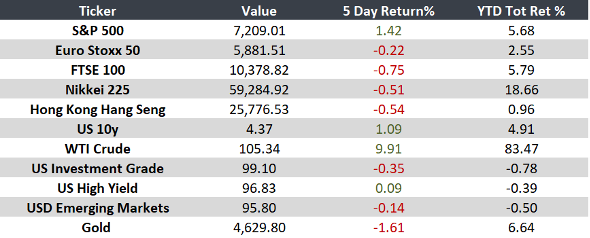
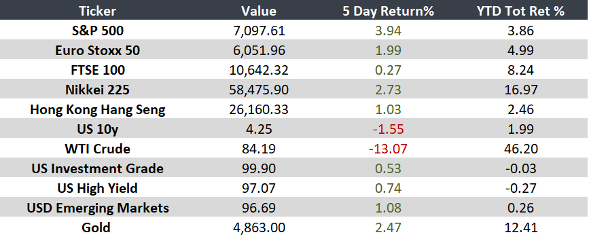
Note: Returns as of April 30th at closing.

Mercados: Estabilidad con señales mixtas

Tasas estables, inflación persistente y crecimiento desigual marcan la semana

Los mercados reflejan estabilidad en política monetaria, pero con mayor divergencia en crecimiento e inflación. El entorno geopolítico sigue presionando expectativas y limitando la visibilidad económica global.

Estados Unidos

La Fed mantuvo tasas (3.5%-3.75%) con una división 8-4, la mayor desde 1992. El PIB creció 2.0%, impulsado por IA y gasto público, pero el consumo se desacelera. Mejora la confianza, aunque persisten presiones inflacionarias.

Europa

El BCE y el BoE mantuvieron tasas, pero advierten riesgos inflacionarios por energía. La inflación sube a 3%, mientras la economía alemana crece 0.3%, reflejando expansión moderada cercana al estancamiento.

Japón

El BoJ mantuvo tasas en 0.75% con división interna ante presiones inflacionarias. Ventas minoristas crecieron 1.7%, impulsadas por el sector automotriz, reflejando una recuperación gradual del consumo.

China

El PMI manufacturero alcanzó su nivel más alto en un año. Sin embargo, el alza en costos de insumos por energía y metales introduce presión sobre márgenes y sostenibilidad del crecimiento.

Argentina

Fitch Ratings y Moody’s mantienen una visión cautelosa, señalando riesgos por inflación persistente, debilidad institucional y dependencia de ajustes fiscales.

Brasil

El banco central recortó la tasa a 14.50%, apoyado por una inflación menor a lo esperado (4.37%). El ciclo de ajuste continúa pese a la incertidumbre global.

México

El PIB cayó 0.8% en el 1T, con debilidad generalizada. A pesar de exportaciones récord (+27.7%), el dinamismo externo aún no se traduce en crecimiento interno.

“All intelligent investing is value investing. Acquiring more than you are paying for. You must value the business in order to value the stock.” – Charlie Munger

TABLA EVENTOS IMPORTANTES

  • En Estados Unidos, se dará a conocer el PMI de servicios 05/05
  • En Estados Unidos, se darán a conocer las nóminas no agrícolas 05/08

Monitor

Nota: Rendimientos indicativos 30 de abril al cierre.

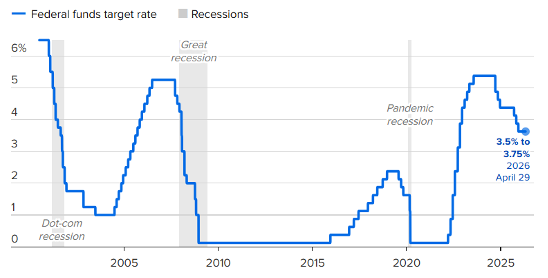
Fed: Rates unchanged, but internal divide grows

The Federal Reserve kept its benchmark rate unchanged at 3.5%–3.75%, in line with expectations. However, the vote revealed an unusual level of division, with four officials dissenting, the highest since 1992. While some policymakers pushed back against signaling future cuts, another voted in favor of lowering rates. Rising geopolitical tensions, particularly in the Middle East, are increasing uncertainty and complicating the balance between persistent inflation and signs of economic slowdown.

Mixed signals from within

The Fed’s message is more nuanced than the decision itself. Stable rates contrast with a growing internal debate over the policy path ahead. Higher energy prices continue to pressure inflation, while the labor market shows signs of weakening. This backdrop points to increased volatility, with limited visibility on rate cuts and macro risks balanced in both directions.

Source: CNBC

Markets: Stability with Underlying Risks

Market stability, energy pressures, and mixed growth signals shaped the week.

Markets remained stable amid signs of easing geopolitical tensions. However, risks related to energy, inflation, and slowing growth persist across regions.

United States

Stable markets and strong consumption. A resilient labor market and tariff refunds support the outlook, while the Fed remains cautious.

Europe

Energy pressures push prices higher as investor confidence declines. Weak industrial signals contrast with some resilience in consumption.

Japan

Moderate inflation and strong export growth driven by technology demand, with pressure from higher energy imports.

China

Solid growth reduces the need for stimulus. Stable rates reflect confidence in current economic dynamics.

Argentina

Economic activity declines, led by weakness in manufacturing, highlighting a fragile economic environment.

Brazil

Positive export outlook, though dependent on the implementation of the EU trade agreement.

Mexico

Inflation moderates, but investment drops sharply. Consumption remains strong, reflecting a mixed economic outlook.

The week was shaped by diverging signals across regions. While the United States and China maintain positive dynamics, Europe and several emerging economies face structural challenges in energy, investment, and growth. Understanding these divergences is key to evaluating the global positioning of a portfolio.

Monitor

Source: Internal analysis based on market data as of April 24, 2025.

Private Credit

An introduction to this asset class

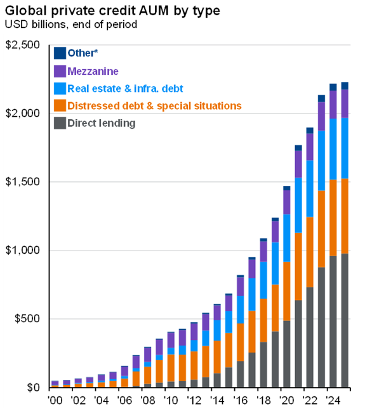
Private credit involves providing direct financing to companies outside the traditional banking system, with structures negotiated on a case-by-case basis. Its growth stems from post-crisis regulatory changes that limited banks’ ability to serve certain market segments, creating space for institutional investors and specialized managers to step in.

Appeal and considerations

Its primary appeal is the generation of recurring income through generally floating-rate instruments, which offer natural protection in high-rate environments. From a diversification standpoint, its low correlation with public assets can help reduce portfolio volatility. That said, it comes with lower liquidity and medium to long-term commitments.

Key factors to evaluate

Evaluating private credit requires attention to three factors: borrower quality, deal structure, and the stage of the economic cycle. Not all strategies are alike — some prioritize stability and income, while others take on higher risk in pursuit of greater returns. Identifying which approach aligns with portfolio objectives is the starting point for incorporating this asset class in a strategic way.

Source: JP Morgan

Markets: Lower Volatility, Mixed Signals

Lower volatility, persistent inflation, and mixed growth signals shaped the week.

Markets experienced lower volatility amid expectations of easing geopolitical tensions. However, inflationary pressures persist alongside mixed growth signals across both developed and emerging economies.

United States

Lower volatility and the S&P 500 reached record highs. Moderate producer inflation and a resilient labor market support a growth environment with contained pressures.

Europe

Inflation rises due to energy, while industrial activity remains weak. The UK stands out with growth driven by services and construction.

Japan

Production grows marginally, and the BoJ may accelerate rate hikes. Slower growth is expected in the coming years.

China

Solid GDP growth, but mixed signals in consumption and employment point to an uneven recovery.

Argentina

Inflation remains elevated despite slight moderation, reflecting ongoing macroeconomic pressures.

Brazil

Consumption slows and industrial confidence declines, signaling deterioration in economic activity.

Mexico

Inflation pressures lead to price control measures. Trade risks rise amid potential changes to USMCA rules.

“Patience is not passive; it is concentrated strength.” – Bruce Lee

Key upcoming events

  • Retail sales data to be released on April 21
  • Employment-related data to be released on April 23

Monitor

Ponte en contacto con nosotros

Receive the best financial market news

Cookie Policy

We use our own and third party cookies to improve our services and show you advertising related to your preferences, by analyzing your browsing habits. By continuing, you confirm that you have read and accept this policy.