Weekly Comment

U.S. core inflation cools further 

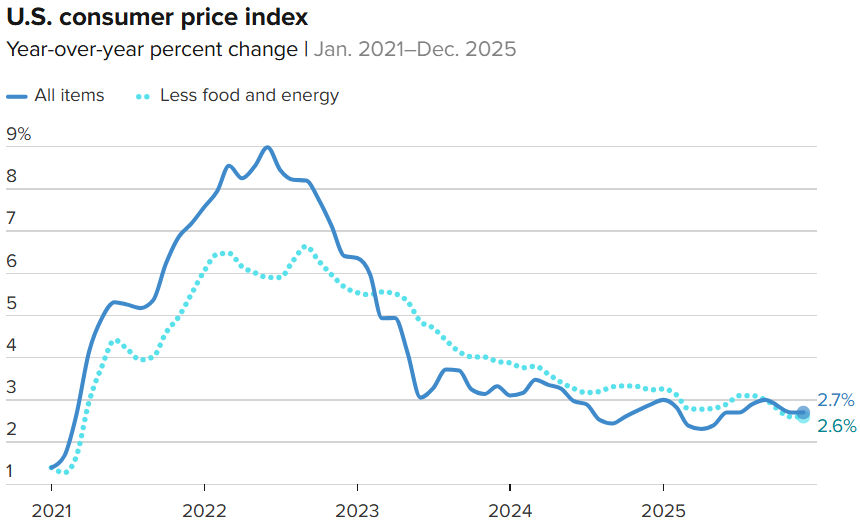
U.S. core inflation came in softer than expected in December, reinforcing the view that underlying price pressures are gradually easing. Core CPI rose just 0.2% month over month and 2.6% year over year, both below consensus, pointing to a continued normalization of inflation dynamics. Still, headline inflation remains at 2.7%, meaning price stability has not yet been fully restored.

What’s holding the Fed back is the composition of inflation. Housing costs, more than a third of CPI, continue to rise at an elevated pace, while services, recreation, and airfares remain sticky. Even as some goods show deflation, the Fed is still waiting for economic data and assessing the effects of previous cuts, limiting the case for near-term rate cuts. Markets now expect the Fed to remain on hold at least through the first half of the year.

Market Implications

  • It reinforces the scenario of inflation slowing down, but too slowly to justify immediate interest rate cuts.
  • Risks in the housing and services sectors reduce the likelihood of an accelerated monetary stimulus cycle.
  • Makes upcoming inflation and labor data critical for market direction.

Source: CNBC with information from U.S. Bureau of Labor Statistics

U.S. Intervention in Venezuela: Market Implications 

U.S. forces captured Nicolás Maduro and his wife, Cilia Flores, in Caracas through an operation that included air strikes on military targets. President Trump stated that his administration will temporarily assume control of Venezuela’s governance. Venezuela’s Supreme Court subsequently appointed Delcy Rodríguez as interim president, leaving open the possibility that she could remain in power for an extended period.

Market Reaction: Limited Impact, Targeted Opportunities

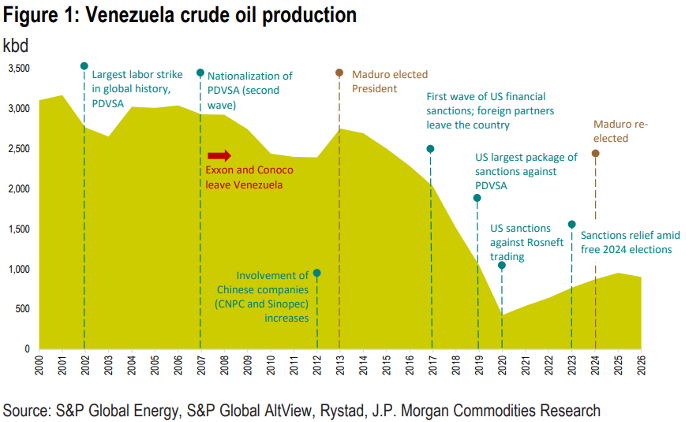
Initial market reactions were concentrated in commodities. Gold prices rose amid heightened geopolitical uncertainty, while oil prices edged modestly lower. Despite holding the world’s largest proven oil reserves, Venezuela’s oil production remains depressed at approximately 900–950 thousand barrels per day. With political stability and renewed licensing, production could increase by roughly 250 thousand barrels per day in the near term, reaching 1.3–1.4 million barrels per day within two years. A more substantial recovery, however, would require investments exceeding USD 200 billion, according to JP Morgan estimates.

From the perspective of traditional financial markets, Venezuela has marginal relevance. Its sovereign debt has been in default since 2017, with total external liabilities estimated at USD 150–170 billion. Nominal GDP, estimated by the IMF at USD 82 billion for 2025, is likely closer to USD 60 billion at current exchange rates—less than half of its pre-crisis size.

Pragmatism Over Idealism: Understanding the Potential Transition Phases

What is unfolding is not a conventional democratic transition, but rather a geopolitical operation consistent with historical precedents. We view the transition as potentially unfolding across three phases:

Phase 1: Containment and Control (Current)

The immediate priority is to prevent institutional collapse and widespread violence. This explains Delcy Rodríguez’s role in ongoing negotiations: she represents administrative continuity across ministries, PDVSA, and the banking system; maintains channels with the armed forces and intelligence services; and retains the ability to execute orders on the ground. In acute crises, operational control often outweighs electoral legitimacy.

Why is María Corina Machado not at the table? She does not control weapons, territory, or logistical infrastructure. For the core Chavista power structure, she represents an existential threat. President Trump was explicit: “I think it would be very difficult for her to be the leader. She does not have internal support or respect within the country.” Secretary Rubio added that “the vast majority of the opposition is no longer present in Venezuela,” further limiting the scope for immediate elections.

Phase 2: Power Rebalancing

Once security stabilizes, civilians, technocrats, and new political figures are expected to enter the process. This phase would involve institutional rebuilding, restoration of basic services, and international normalization.

Phase 3: Democratic Legitimation (Uncertain Timeline)

With functional institutions and contained violence, free elections and broader economic normalization become feasible. This sequencing is consistent with successful transitions observed in the Southern Cone and Eastern Europe.

Path to Reconstruction: Oil and Normalization

Secretary Rubio stated that the oil “quarantine” remains in place, affecting approximately 400 thousand barrels per day of exports, based on public data. Logical next steps would include formal diplomatic recognition and an expansion of licenses, eventually paving the way for debt restructuring.

A fast-tracked bilateral agreement anchored in oil—potentially outside the IMF framework—could lead to a less orthodox restructuring than under the G20 Common Framework. Under our estimates, Republic and PDVSA bonds would likely be treated similarly, potentially incorporating a value recovery instrument (VRI) linked to oil production or prices.

Opportunities for Sophisticated Investors

Venezuelan bonds approximately doubled in price during 2025, and we are currently observing an additional 8–10 point rally this week. In an environment where single-B emerging market sovereigns are trading at five-year low yields (7.6%) and 18-year tight spreads (343 basis points), Venezuela offers a combination of relative value and a compelling normalization narrative.

Given the scale of Venezuela’s oil resources and the U.S. administration’s determination to extract economic returns from its intervention, market participants are likely to remain constructive. Technical analysis suggests value in bonds without collective action clauses and in instruments where accrued interest is less fully reflected in market prices. That said, it is important to emphasize that visibility on a comprehensive debt restructuring remains limited, and there is statute-of-limitations risk for bonds purchased after the publication of the Tolling Agreement in August 2023, which extended the prescription period for defaulted bonds from 2023 to 2028.

For investors with higher risk tolerance, we see emerging opportunities that we are actively evaluating:

Sovereign debt restructuring: Bonds with still-valid maturities and more recent issuance dates could see higher recovery values, particularly as a way to minimize exposure to unpaid accrued interest, which could face significant haircuts in a restructuring scenario.

*Bond secured by 50.1% of CITGO Holdings shares

Traditional Financial Markets

While a potential lifting of U.S. sanctions and renewed investment could support higher oil production, the process would be complex and span multiple years, given decades of underinvestment and infrastructure deterioration. Venezuela currently represents roughly 1% of global oil supply, amid persistent political, legal, and security risks, as well as the structural disadvantage of producing extra-heavy crude, which is less valuable than light crude and reduces its attractiveness to international investors. As a result, we do not currently view this exposure as particularly compelling.

Direct exposure to publicly listed companies outside the energy sector is generally limited relative to oil, given the historical dominance of the state across large parts of the economy (including telecommunications and banking), as well as sanctions and capital controls. In this context, any potential upside for non-energy companies would depend primarily on policy reforms, sanctions relief, and improved legal and financial certainty, rather than near-term operational improvements.

For further discussion or to receive our detailed analysis, please contact your investment advisor at Activest.

Source: Internal analysis Activest

Private debt under pressure in a more challenging environment 

Private debt, though a core component of institutional portfolios for several years, is currently experiencing strong growth. However, a challenging macroeconomic backdrop and multiple structural forces are reshaping the dynamics of private financing.

Aging populations and declining birth rates are reducing demographic growth, further increasing the cost of capital. At the same time, the energy transition, national defense, digital infrastructure, and other strategic priorities require trillions of dollars in annual investment, creating fierce competition for scarce capital.

Additionally, regulatory pressure, deglobalization, and macroeconomic volatility are increasing liquidity risk across certain segments of private debt. While the asset class remains attractive due to its ability to generate above-market returns, a more rigorous assessment of credit risk has become essential.

Key Data: 

  • Aging populations increase the cost of capital 
  • Energy transition and infrastructure demand trillions annually 
  • Regulatory pressure and deglobalization heighten liquidity risk 
  • The era of cheap capital is over 

Conditions have changed. Selectivity and credit quality are now more important than ever. Although private debt offers attractive returns, the current environment demands more rigorous analysis. A disciplined approach to credit quality and liquidity risk assessment enables capturing opportunities without compromising portfolio soundness.

Source: Activest/Axxets Internal Analysis 

Fed: Mixed Signals After the Latest Rate Cut

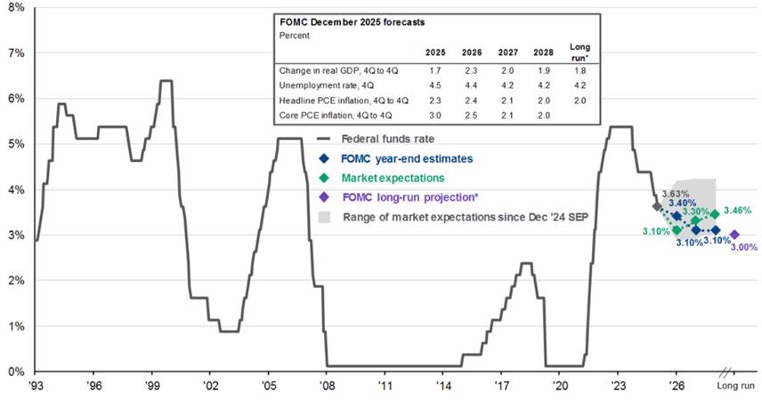
The Federal Reserve delivered its third consecutive rate cut, lowering the federal funds rate to a range of 3.50%–3.75%. While the move was widely anticipated, the accompanying statement revealed rising uncertainty about the policy path ahead. The committee showed an unusual split between members focused on labor-market weakness and those still concerned about persistent inflation pressures.

The updated dot plot, which reflects policymakers’ rate expectations, pointed to just one additional cut in 2026 and another in 2027. Although the projected path remained unchanged, it underscored diverging views within the committee regarding the appropriate level of interest rates over the medium term.

The latest rate cut confirms that the Fed maintains an accommodative bias, but the internal divisions suggest that the pace of future adjustments is likely to slow. In this environment, markets are expected to remain highly sensitive to incoming employment, inflation, and monetary policy expectation data throughout 2026.

Source: JP Morgan

Is the Santa Claus Rally real?

A seasonal rally or just a myth? 

The “Santa Claus Rally” describes a historical pattern: markets tend to rise during the final days of December and early January. We analyze its consistency and what to expect heading into 2025. 

In the financial world, the “Santa Claus Rally” describes a historical pattern: markets tend to rise during the last five trading days of December and the first two of January. According to the Stock Trader’s Almanac, this phenomenon has occurred approximately 78%–80% of the time since 1972, with an average return of 1.3% to 1.4% for the S&P 500. 

Possible reasons range from lower trading volume as many institutional investors take time off, to a more optimistic emotional tone driven by the holidays, year-end bonuses, and portfolio adjustments like rebalancing or tax-loss harvesting. 

However, it doesn’t always happen. Over the past decade, the effect has been weaker, with average returns around 0.38%. Factors like inflation, elevated rates, geopolitical tensions, or economic surprises have completely negated this seasonal boost. 

Key Takeaways: 
✓ While the Santa Claus Rally has shown historical consistency, factors like elevated rates, inflation, and volatility limit its reliability as a strategy. If it happens, view it as an extra boost—not a basis for decision-making. 
 
✓ The Santa Claus Rally refers to the market uptick during the last five trading days of December and the first two trading days of January. 

Stablecoins: Innovation or silent threat to money?

Stablecoins pose a structural challenge to global monetary policy, potentially driving persistent inflation above central bank targets. Central banks don’t regulate or control stablecoin issuance, limiting their ability to adjust money supply across economic cycles. While currently backed 1:1 by fiat, a shift to fractional reserves could amplify inflation. 24/7 DeFi transactions accelerate monetary velocity, amplifying liquidity and inflationary pressures. Stablecoin-backed DeFi lending creates excessive leverage, risking bubbles that affect both crypto ecosystems and real-world assets. 

Key data: 

  • Stablecoins monetize otherwise immobilized assets (dollars, Treasuries) 
  • 24/7 transactions outside central bank control 
  • Long-term rates could reach ~3.5% 
  • 150 basis points above the past decade 

Stablecoins aren’t just redefining global liquidity; they’re silently expanding the foundation for structural inflation. Combined with demographics, energy transition, and deglobalization, they drive structural inflation, affecting monetary policy and asset class returns. 

Stablecoins: The Hidden Key Piece Driving Interest Rates and Global Liquidity

Stablecoins are no longer a theoretical exercise but have become part of the global financial market. With a capitalization exceeding $200 billion and high growth, their impact on the global economy is undeniable. Despite this, they remain excluded from monetary indicators like the M2 Money Supply. This omission is, in our opinion, a technical legacy that must soon be corrected. 

Stablecoins meet all M2 criteria: near-immediate liquidity, backing by fiat money like USD, and transactional use. They function as a new layer of private global money, operating in parallel to the traditional system. These assets monetize immobilized assets (like Treasury bonds), increasing the effective monetary base without central bank intervention. 

Key Data Points: 

  • Capitalization exceeds $200 billion. 
  • Meet all M2 criteria (liquidity, fiat backing, transactional use). 
  • They monetize Treasury bonds, increasing the effective monetary base. 
  • Their exclusion may imply recognizing higher inflation. 

Institutional resistance to including them in official statistics is not due to a lack of merit, but structural inertia and a possible political dilemma. The expansion of stablecoins represents an evolution in monetary architecture. Ignoring them is a risk; incorporating them into M2 is a necessity. 

A divided Fed: what’s next for the markets?

The Federal Reserve has not reached a clear agreement on its next steps. 

A few weeks ago, the Fed cut its rate by 25 bps, but the real surprise came from the vote: one member called for a deeper cut, while another preferred none at all. 
Two opposing positions that reveal an important fact: the economy is sending mixed signals

In this scenario, Jerome Powell was clear: a December cut is not guaranteed. 
Rather than dysfunction, this division shows that the path ahead remains uncertain. 
Why is the Fed divided? Because economic data continue to send conflicting and inconsistent signals

Key points: 
☑ Stock market at record highs 
☑ Accelerating investment in AI 
☑ Resilient consumer spending 
☑ Labor market losing momentum 
☑ Housing sector stagnating 
☑ Rising layoffs and credit card delinquencies 
☑ Government shutdown delaying key data, reducing visibility for both the Fed and the markets 

A divided Fed doesn’t imply chaos, but rather caution in the face of an ambiguous economy and incomplete data

The message for investors is clear: it’s not about predicting the next move, but about staying disciplined and focused on long-term horizons

Source: Morningstar 

Fed cuts again but remains cautious

The Federal Reserve delivered its second rate cut of the year, lowering the policy rate by 25 bps to a range of 3.75%–4%. It announced that it will halt its balance sheet reduction in December. 

The Fed acknowledged moderate growth but warned of rising labor market risks.  The vote was 10–2, reflecting divided positions. 


Powell: another cut in December is not guaranteed. 

Key Data: 

  • Second rate cut of 2025 
  • Rate range: 3.75%–4% 
  • Vote: 10–2 
  • Balance sheet runoff to end in December 
  • Labor market risks on the rise 


The market continues to expect a possible third rate cut in December, though signals remain mixed. 
The Fed remains cautious and data-dependent, with employment as a key variable guiding the rate path. 

U.S. Government Shutdown: Political Uncertainty, Market Resilience 

The U.S. government shutdown is once again testing market patience amid stalled negotiations and disagreements over public spending. Unlike previous shutdowns, this time there is talk of permanent layoffs instead of temporary furloughs, which could have a stronger impact on employment and domestic consumption. However, historical evidence suggests that such events tend to have a limited effect on financial asset performance over the medium and long term. The main market drivers remain fundamentals: inflation, interest rates, earnings, and employment. 

Key Data: 

  • Average government shutdown duration: 9 days 
  • Longest shutdown: 34 days (2018–2019) 
  • Potential permanent layoffs could have longer-lasting effects 

The key is to stay focused, avoid hasty decisions, and rely on diversification as protection against political noise. 

Source: Capital Group  

Ponte en contacto con nosotros

Receive the best financial market news

Cookie Policy

We use our own and third party cookies to improve our services and show you advertising related to your preferences, by analyzing your browsing habits. By continuing, you confirm that you have read and accept this policy.