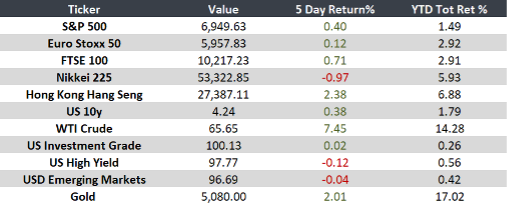
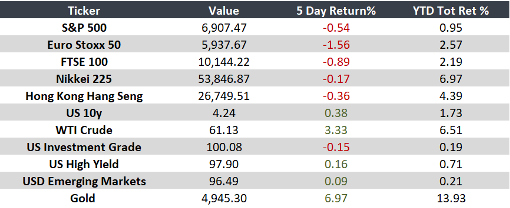
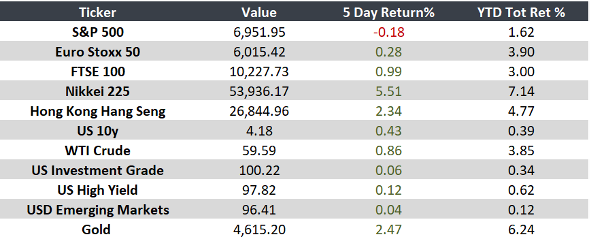
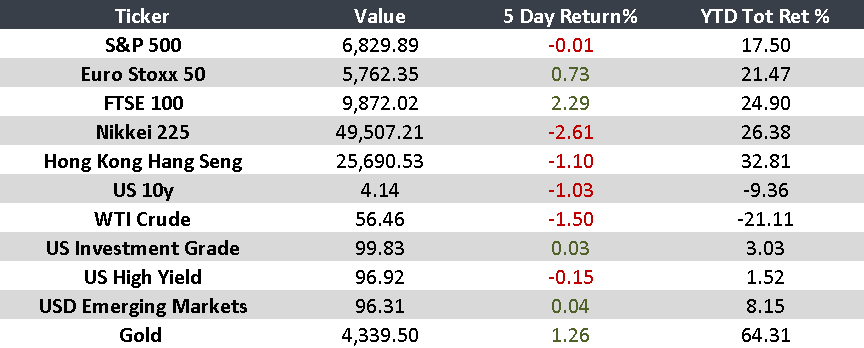
Weekly Summary

Global outlook: inflation, growth, and trade 

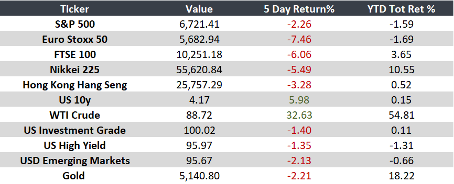
Global markets reflect a balance between solid growth in developed economies, persistent inflationary pressures in certain sectors, and ongoing monetary policy adjustments in emerging markets.

United States

The Fed kept rates at 3.5%–3.75% amid solid growth and stable employment. PPI rose 0.5% month on month, and the trade deficit widened in November, potentially weighing on Q4 GDP.

Europe

Eurozone GDP grew 1.3% YoY in Q4 2025, exceeding expectations. Germany expanded 0.4% YoY, with inflation rising due to food prices, while services inflation eased and consumer confidence improved.

Japan

Service-sector prices rose 2.6% YoY in December. Labor shortages and a weaker yen are pushing costs higher, reinforcing the BoJ’s case for continued monetary policy normalization.

China

The government will prioritize domestic consumption of goods and services in 2026 to reduce industrial overcapacity and external dependence, supporting sectors such as tourism, transportation, and digital services.

Argentina

The IMF reaffirmed a 4% growth outlook for Argentina in 2026 and 2027. Globally, it projects 3.3% growth, conditioned by trade tensions, technology investment, and political uncertainty.

Brazil

Brazil’s Central Bank kept its policy rate at 15.00%. A prolonged pause is expected amid risks from services inflation and FX volatility, with the goal of converging to the 3.2% inflation target by 2027.

Mexico

Mexico’s economy grew 0.7% in 2025, beating expectations. Exports rose 7.6%, driven by non-automotive manufacturing. Unemployment ended the year at 2.4%, and Banxico is considering gradual rate cuts.

Key upcoming events 

  • In the United States, the Manufacturing Purchasing Managers’ Index (PMI) will be released on 02/02 
  • In the United States, the Nonfarm Payrolls report will be released on 02/06 

“Waiting helps you as an investor and a lot of people just can’t stand to wait.” – Charlie Munger 

Monitor

Global outlook: growth and inflation in focus 

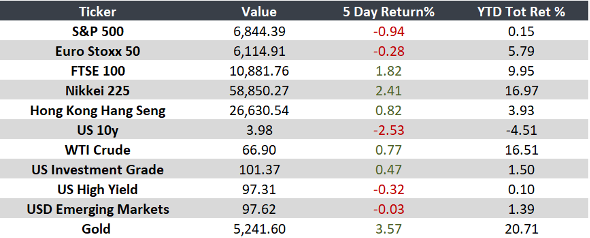
Global markets reflect a balance between resilient growth, easing inflation in some regions, and persistent pressures in others, shaping monetary policy expectations and economic activity in 2025. 

United States 

Q3 GDP was revised up to a 4.4% annualized rate, driven by exports, business investment, and strong consumer spending. The Federal Reserve is expected to keep rates at 3.50%–3.75% this quarter, reflecting a cautious stance amid mixed economic data. 

Europe 

Eurozone inflation closed 2025 at 1.9%, below the European Central Bank’s 2% target. Germany’s economic confidence improved after several difficult quarters, while the United Kingdom continues to face persistent inflation pressures that complicate monetary policy decisions. 

Japan 

Inflation eased to 2.1% year over year in December. Lower energy prices offset underlying pressures, although core inflation remains above the Bank of Japan’s target, maintaining uncertainty about future monetary adjustments. 

China 

GDP grew 4.5% in the fourth quarter, weighed down significantly by the real estate sector. Weak consumption contrasts with a late-year rebound in industrial production, reflecting an uneven economic landscape that requires targeted stimulus measures.

Argentina 

Economic activity fell 0.3% year over year in November, its first contraction in 14 months, despite solid performance in agriculture and mining sectors. The economy shows signs of weakness in other key sectors. 

Brazil 

Business confidence improved slightly but remains in pessimistic territory. Concerns persist about the pace of the domestic economic recovery, with worries about sustained medium-term growth. 

Mexico 

Inflation rose in the first half of the year, while consumption remained strong, supported by higher retail sales and e-commerce growth. The consumer dynamics contrast with moderation in other economic indicators. 

Key upcoming events 

  • In the United States, the FED monetary policy decision will be announced on January 28 
  • In the United States, the Producer Price Index (PPI) will be released on January 30 

“The big money is not in the buying and selling, but in the waiting.” – Charlie Munger 

Monitor

Global Economic Outlook: Mixed Signals 

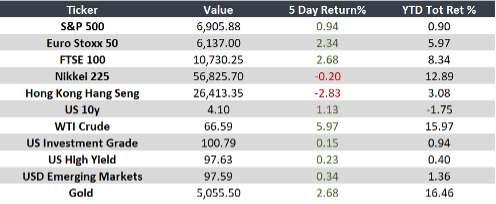
In a relatively calm week, employment and consumption indicators provided key signals across major economies. Central bank decisions continue to reflect a cautious, data – dependent approach, while global economies show divergences between production and consumption that reinforce the need for selective analysis heading into 2025.

United States 

  • Nonfarm payrolls exceeded expectations, adding 64,000 jobs in November. 
  • The unemployment rate rose to 4.6%. 
  • Headline inflation eased to 2.7% and core inflation to 2.6%. 

Europe 

  • The ECB held rates at 2.15% and revised its growth outlook. 
  • Eurozone inflation stood at 2.1%. 
  • Germany and Spain recorded 2.6% and 3.2%, respectively. 
  • The United Kingdom cut its policy rate to 3.75%. 

China 

  • Industrial production grew 4.8% year over year in November. 
  • Retail sales rose just 1.3%, the weakest increase since December 2022. 
  • Sharp declines in automobiles, household appliances, and construction materials. 

Argentina 

  • GDP expanded 3.3% year over year in 3Q, below expectations. 
  • Manufacturing output declined 2.4%. 
  • The unemployment rate fell to 6.6%, approaching historical lows. 

Brazil 

  • Economic activity declined 0.2% month over month. 
  • Agriculture helped prevent a deeper contraction. 
  • The central bank revised its GDP growth forecast upward and maintained a restrictive stance to contain inflation. 

Mexico 

  • Banxico cut its policy rate to 7%. 
  • Retail sales increased 3.4% year over year, driven by strong online sales. 
  • Employment in the sector rose 1%, while wages increased 3.3%. 

“The first rule of compounding: Never interrupt it unnecessarily.” — Charlie Munger 

Key Upcoming Events 

  • United States: Quarterly GDP growth release — December 23 
  • United States: Labor market data release — December 24 

Monitor 

Returns as of 10 AM EST 

Fed splits opinions and key data ahead 

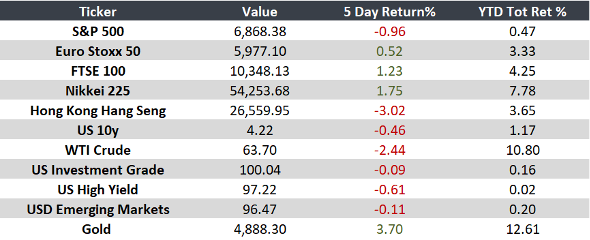
Markets reacted to the Federal Reserve’s latest rate cut amid a set of mixed signals on inflation, production, and employment across major economies. The week was shaped by U.S. labor data, an industrial rebound in Europe, and contrasting dynamics in Asia and Latin America, reinforcing a cautious outlook for monetary policy heading into 2026. 

United States 

  • The Fed cut rates to a range of 3.50%–3.75%, with three dissenting votes. 
  • Policymakers signaled only one additional adjustment in 2026. 
  • Labor cost growth moderated. 
  • Job openings remained stable, pointing to easing wage pressures. 

Europe (Germany) 

  • Industrial production rose 1.8% in October, the strongest increase since March. 
  • Growth was driven by machinery and electronics. 
  • Exports increased 0.1%, supported by intra-EU trade, despite weaker shipments to the U.S. and China. 

Japan 

  • Producer prices rose 2.7% year over year in November, unchanged from the previous month. 
  • The strongest increases were seen in nonferrous metals and food & beverages. 

China 

  • Annual inflation rebounded to 0.7%, the highest level since February. 
  • Food prices rose for the first time in ten months. 
  • Producer prices fell 2.2%, extending a 38-month contraction amid weak domestic demand. 

Brazil 

  • Annual inflation declined to 4.46%, its lowest level since September 2024. 
  • The Central Bank held its policy rate at 15.00%. 
  • Authorities signaled a prolonged pause to ensure convergence toward the inflation target. 

Mexico 

  • Inflation rose to 3.80% year over year, the highest reading since June. 
  • Auto production fell 8.4% year over year in November. 
  • Year-to-date, production is down 1.5%. 

“The single greatest edge an investor can have is a long-term orientation.” 
— Seth Klarman 

Key Upcoming Events 

  • United States: Nonfarm payrolls report — December 16 
  • United States: November inflation report — December 18 

Monitor 

Returns as of market close on December 11. 

Mixed signals: weak manufacturing, moderating labor data, and rising expectations of rate cuts 

Markets ended the week focused on the persistent weakness in global manufacturing activity and the continued loss of momentum in the U.S. labor market. In this environment, expectations for a potential interest rate cut before year-end strengthened. Europe and Asia showed mixed signals, while Latin America posted contrasting results across growth and income indicators. 

United States: 

  • Manufacturing contracted for the ninth consecutive month, while the services sector recorded its strongest expansion in nine months. 
  • Private employers cut 32,000 jobs, reinforcing expectations of a December rate cut, now priced with an 87% probability. 

Europe: 

  • The Bank of England reduced capital requirements for the first time since 2008 in an effort to stimulate lending. 
  • Eurozone inflation reached 2.2% year over year, with services remaining the main driver. 

Japan: 

  • The services sector maintained a solid pace of expansion in November, supported by rising new orders and improved business confidence. 

China: 

  • Manufacturing contracted for the eighth straight month, while services grew at their slowest pace in five months. 
  • Analysts expect additional expansionary measures to help sustain a growth target near 5% in 2026. 

Brazil: 

  • GDP grew 1.8% year over year in 3Q25, its weakest reading since 2022. 
  • Agriculture and industry remained the main contributors despite the slowdown. 

Mexico: 

  • Remittances fell 1.7% year over year in October, marking the smallest decline since April. 
  • The minimum wage will increase 13% in 2026 to 315.04 pesos per day, a cumulative rise of 150% since 2018. 

“Risk comes from not knowing what you’re doing.” — Warren Buffett 

Key Upcoming Events: 

  • United States: Employment data release — Dec 9 
  • United States: Federal Reserve monetary policy announcement — Dec 10 

Monitor

Rate Cuts: How Close Are We? 

In a holiday-shortened week, U.S. labor data and inflation trends in Latin America took center stage. Expectations around the Federal Reserve’s next move are once again driving market sentiment. 

United States: 

  • Consumer confidence fell to its lowest level since April, and layoffs continued to rise, pushing the probability of a December rate cut to 84%, up from 39% the previous week. 

Europe: 

  • Business confidence in Germany unexpectedly weakened. In the United Kingdom, the new fiscal budget includes tax increases amid an environment of sluggish economic growth. 

Japan: 

  • Prime Minister Sanae Takaichi heightened diplomatic tensions with China after stating that Japan could intervene if Beijing acts against Taiwan, adding uncertainty to the regional outlook. 

China: 

  • Industrial profits fell 5.5% in October, while the government adopted a firmer stance regarding Taiwan, amplifying geopolitical risks across Asia. 

Brazil: 

  • Annual inflation slowed to 4.50% in November, returning to the central bank’s target range for the first time since January—an outcome welcomed by markets. 

Mexico: 

  • Inflation rose to 3.61% in the first half of November. Banxico revised its 2025 growth forecast down from 0.6% to 0.3%, while keeping its 2026 estimate unchanged at 1.1%. 

“The thesis underlying everything, whether you’re an actively managed fund or a passive fund, is that the U.S. will be OK. If you don’t believe that, you shouldn’t be in the stock market.” — Peter Lynch 

Key Upcoming Events: 

  • United States: Second estimate of Q3 2025 GDP and ISM Manufacturing — December 2 
  • United States: ISM Services Index — December 3 

Monitor

Jobs, the Fed, and Growth: A Week of Mixed Signals 

The U.S. labor market returned to the spotlight this week, while Europe maintained a stable tone and Japan showed signs of cooling. In Mexico, foreign direct investment continued to strengthen. Here are the key topics to watch. 

United States: 

• The economy added 119,000 jobs in September, above expectations, although the unemployment rate rose to 4.4%. 
• The Fed remains divided, and the probability of a December rate cut currently stands at 40%. 

Europe: 

• Inflation remains stable near 2%, and the ECB is expected to keep rates unchanged at least through the end of 2026. 
• In the UK, inflation fell to 3.6%, potentially opening the door for a rate cut by the Bank of England in December. 

Japan: 

• GDP fell 1.8% annualized in the third quarter, with a quarterly contraction of 0.4%. 
• Exports were the main drag, reflecting a weaker external backdrop. 

China: 

• For the sixth consecutive month, the central bank kept its benchmark lending rates unchanged. 
• The decision was in line with expectations as the economy seeks stability amid domestic challenges. 

Mexico: 

• FDI grew 14.5% year-over-year from January to September, surpassing $40 billion. 
• Economic activity showed no change in October, both month-over-month and compared with the same month in 2024. 

“Be fearful when others are greedy and greedy only when others are fearful.” — Warren Buffett 

Key Upcoming Events: 

• U.S.: Beige Book release — 11/26 
• U.S.: Thanksgiving Day (market holiday) — 11/27 

Monitor

Global Outlook: Mixed Signals in Inflation and Employment Amid Divided Fed Stances 

Markets moved through a week of soft economic activity in the U.S. and mixed signals across global regions. Key developments included monetary policy adjustments, moderate growth figures, and relevant updates on inflation and employment. This backdrop underscores the importance of analyzing structural trends, not just short-term market moves. 

  • United States: The agreement to fund the government through January ended the longest shutdown on record, while the Fed showed mixed views on future rate cuts. The technology sector remained volatile amid valuation concerns. 

  • Europe: The U.K. labor market weakened, with unemployment rising to 5.0%—its highest level since 2021. 3Q25 growth slowed, reinforcing expectations for a Bank of England rate cut. The eurozone economy continued to expand at a modest pace in the third quarter. 

  • Japan: The Bank of Japan reiterated that it aims for moderate inflation supported by wage growth and improving economic conditions, in line with the government’s broader growth strategy. 

  • China: Producer prices fell 2.1% year over year—less than expected—while consumer inflation rose 0.2%, reversing two months of declines. Industrial production and retail sales also delivered weak readings. 

  • Brazil: Monthly inflation rose 0.09%, helped by lower electricity tariffs, while the annual figure dropped to 4.68%. The central bank is preparing additional regulations to address the increase in cyberattacks. 

  • Mexico: Industrial activity fell 3.3% in September, marking seven consecutive months of contraction. Banxico expects inflation to converge to 3% by 3Q26 and anticipates only limited impact from new taxes. 

“We don’t prognosticate macroeconomic factors; we’re looking at our companies from a bottom-up perspective on their long-run prospects of returning.” – Mellody Hobson 

Key Upcoming Events:  

  • United States: Industrial production – 11/18. 
  • United States: Federal Reserve minutes – 11/19. 

Monitor

Week of stable rates and mixed signals in manufacturing

Markets reflected a week of steady interest rates, weaker manufacturing data, and resilience in services. In the United States, the government shutdown remains unresolved, while year-end spending shows a more moderate tone compared with 2024. 

United States: 
Concerns over AI valuations drove market sentiment. Manufacturing activity declined, but the services sector rebounded. The government shutdown set a new record, and year-end spending is expected to moderate. 

Europe: 
Eurozone manufacturing stalled due to a lack of new orders, although production continued to grow. The Bank of England kept its policy rate at 4%, as expected. 

Asia: 
In Japan, manufacturing posted its worst reading in more than a year, pressured by weak demand in autos and semiconductors. The services sector remained resilient despite a slower pace of new orders. 
In China, manufacturing activity fell to its lowest level in six months. Services expanded but at the slowest pace since July, mainly due to weaker export demand. 

Latin America: 
In Brazil, the Central Bank held its key rate at 15%, the highest level since 2006, indicating caution amid persistent inflationary pressures. 
In Mexico, Banco de México cut its policy rate to 7.25%, in line with expectations. September remittances fell 2.7% YoY, though they remain above $5 billion. 

“The investor’s chief problem — and even his worst enemy — is likely to be himself.” — Benjamin Graham 

Important Events: 

  • U.S. October inflation data will be released — November 13 
  • U.S. Producer Price Index (PPI) will be published — November 14 

Monitor

Global Financial Outlook: Fed Cuts Rates and U.S. Extends Tariff Truce with China 

The week was marked by mixed signals in global markets following a series of key events. These included the Federal Reserve’s (Fed) second consecutive policy rate cut, the extension of the tariff truce between the United States and China, the stagnation of the German economy, and the improvement in China’s industrial profits. These developments underscore the complexity of the global economic and trade environment. 

United States: 

  • The Federal Reserve cut the policy rate to a range of 3.75% – 4.00%. 
  • Trump and Xi agreed to extend the tariff truce for one more year. 
  • Consumer confidence fell to its lowest level in six months. 
  • Earnings season continues to show strength, with S&P 500 earnings growing about 10% this quarter. 

Europe

  • The European Central Bank (ECB) kept its key rate at 2%. 
  • Germany’s economy stagnated due to weaker exports and ongoing global trade pressures, despite a slight improvement in business sentiment. 

Japan

  • The government highlighted a moderate recovery supported primarily by capital spending. 
  • Caution persists due to risks linked to U.S. trade policy. 

China:

  • Industrial profits rose 21.6% YoY in September, the fastest pace since November 2023. This reflects better capacity utilization. 

Brazil

  • The U.S. Senate approved a bill to revoke tariffs on Brazil by lifting the national emergency declaration issued in July. 

Mexico:

  • Gross Domestic Product (GDP) contracted 0.3%YoY in 3Q25. 
  • According to President Sheinbaum, the United States extended the negotiation period to avoid the implementation of a 30% tariff. 

“Compound interest is the eighth wonder of the world. He who understands it, earns it; he who doesn’t, pays it.” – Albert Einstein 

Key Upcoming Events 

  • U.S.: ISM Manufacturing – Nov 3. 
  • U.S.: ISM Services & employment-related data (tentative) – Nov 5-7. 

Monitor

Ponte en contacto con nosotros

Receive the best financial market news

Cookie Policy

We use our own and third party cookies to improve our services and show you advertising related to your preferences, by analyzing your browsing habits. By continuing, you confirm that you have read and accept this policy.